Appears 4 times in Test+(Année non identifiée Session non spécifiée, Année non identifiée Session non spécifiée, 2019 Session non spécifiée, 2019 Session non spécifiée)
¿Qué cemento formula en su líquido una solución acuosa de ácido ortofosfórico al 50-60 %?
#2
Appears 4 times in Test+(Année non identifiée Session non spécifiée, Année non identifiée Session non spécifiée, 2019 Session non spécifiée, 2019 Session non spécifiée)
¿Cuál de las siguientes es una propiedad ideal de los cementos de uso odontológico?
#3
Appears 4 times in Test+(Année non identifiée Session non spécifiée, Année non identifiée Session non spécifiée, 2019 Session non spécifiée, 2019 Session non spécifiée)
El barrillo dentario o smear layer está compuesto por:
#4
Appears 4 times in Test+(Année non identifiée Session non spécifiée, Année non identifiée Session non spécifiée, 2019 Session non spécifiée, 2019 Session non spécifiée)
En relación a la preparación de la superficie del esmalte previa a la obturación con composite:
#5
Appears 4 times in Test+(Année non identifiée Session non spécifiée, Année non identifiée Session non spécifiée, 2019 Session non spécifiée, 2019 Session non spécifiée)
El sistema de cristalización cúbico a cuerpo centrado:
#6
Appears 4 times in Test+(Année non identifiée Session non spécifiée, Année non identifiée Session non spécifiée, 2019 Session non spécifiée, 2019 Session non spécifiée)
Respecto al Au, señale la falsa:
#7
Appears 4 times in Test+(Année non identifiée Session non spécifiée, Année non identifiée Session non spécifiée, 2019 Session non spécifiée, 2019 Session non spécifiée)
Respecto a las resinas compuestas, señale la respuesta FALSA:
#8
Appears 4 times in Test+(Année non identifiée Session non spécifiée, Année non identifiée Session non spécifiée, 2019 Session non spécifiée, 2019 Session non spécifiée)
¿Cuál es la mayor ventaja de las resinas compuestas autopolimerizables?
#9
Appears 4 times in Test+(Année non identifiée Session non spécifiée, Année non identifiée Session non spécifiée, 2019 Session non spécifiée, 2019 Session non spécifiée)
En las resinas acrílicas, la contracción de polimerización es de aproximadamente:
#10
Appears 4 times in Test+(Année non identifiée Session non spécifiée, Année non identifiée Session non spécifiée, 2019 Session non spécifiée, 2019 Session non spécifiée)
¿En cuál de las fases de la mezcla de las resinas acrílicas el material se vuelve pegajoso y filamentoso?
#11
Appears 4 times in Test+(Année non identifiée Session non spécifiée, Année non identifiée Session non spécifiée, 2019 Session non spécifiée, 2019 Session non spécifiée)
Señale cuál de los siguientes compuestos actúa como acelerador de la reacción de polimerización de las resinas acrílicas termopolimerizables:
#12
Appears 4 times in Test+(Année non identifiée Session non spécifiée, Année non identifiée Session non spécifiée, 2019 Session non spécifiée, 2019 Session non spécifiée)
Una cera que funde de 55° a 90° y se añade a otras ceras para elevar la temperatura de fusión es:
#13
Appears 4 times in Test+(Année non identifiée Session non spécifiée, Année non identifiée Session non spécifiée, 2019 Session non spécifiée, 2019 Session non spécifiée)
Marque la respuesta INCORRECTA respecto a las características de los cementos usados en Odontología:
#14
Appears 4 times in Test+(Année non identifiée Session non spécifiée, Année non identifiée Session non spécifiée, 2019 Session non spécifiée, 2019 Session non spécifiée)
Un cemento de hidróxido de calcio fraguable en presentación pasta-pasta suele incluir como antiséptico:
#15
Appears 4 times in Test+(Année non identifiée Session non spécifiée, Année non identifiée Session non spécifiée, 2019 Session non spécifiée, 2019 Session non spécifiée)
¿Cuál es el material de impresión de elección para realizar prótesis fija por su estabilidad dimensional y muy buena reproducción de detalles?
#16
Appears 4 times in Test+(Année non identifiée Session non spécifiée, Année non identifiée Session non spécifiée, 2019 Session non spécifiée, 2019 Session non spécifiée)
¿Qué tipo de yeso se obtiene por calentamiento húmedo en autoclave (120 °C a 130 °C)?
#17
Appears 4 times in Test+(Année non identifiée Session non spécifiée, Année non identifiée Session non spécifiée, 2019 Session non spécifiée, 2019 Session non spécifiée)
Indique la falsa respecto a los poliéteres como materiales de impresión:
#18
Appears 4 times in Test+(Année non identifiée Session non spécifiée, Année non identifiée Session non spécifiée, 2019 Session non spécifiée, 2019 Session non spécifiée)
¿Cuál de las siguientes indicaciones no es propia de un cemento de vidrio ionómero?
#19
Appears 4 times in Test+(Année non identifiée Session non spécifiée, Année non identifiée Session non spécifiée, 2019 Session non spécifiée, 2019 Session non spécifiée)
¿Cuál es el cemento precursor del CIV?
#20
Appears 4 times in Test+(Année non identifiée Session non spécifiée, Année non identifiée Session non spécifiée, 2019 Session non spécifiée, 2019 Session non spécifiée)
¿Cuál es el cemento precursor del CIV?
#21
Appears 4 times in Test+(Année non identifiée Session non spécifiée, Année non identifiée Session non spécifiée, 2019 Session non spécifiée, 2019 Session non spécifiée)
¿Qué ácido forma parte de la composición del líquido de los cementos de ionómero de vidrio?
#22
Appears 4 times in Test+(Année non identifiée Session non spécifiée, Année non identifiée Session non spécifiée, 2019 Session non spécifiée, 2019 Session non spécifiée)
¿Cuál de los siguientes composites tiene mayor estética?
#23
Appears 4 times in Test+(Année non identifiée Session non spécifiée, Année non identifiée Session non spécifiée, 2019 Session non spécifiée, 2019 Session non spécifiée)
Durante la reacción de cristalización de una amalgama dental de bajo contenido en cobre, ¿qué porcentaje de fase γ se produce?
#24
Appears 4 times in Test+(Année non identifiée Session non spécifiée, Année non identifiée Session non spécifiée, 2019 Session non spécifiée, 2019 Session non spécifiée)
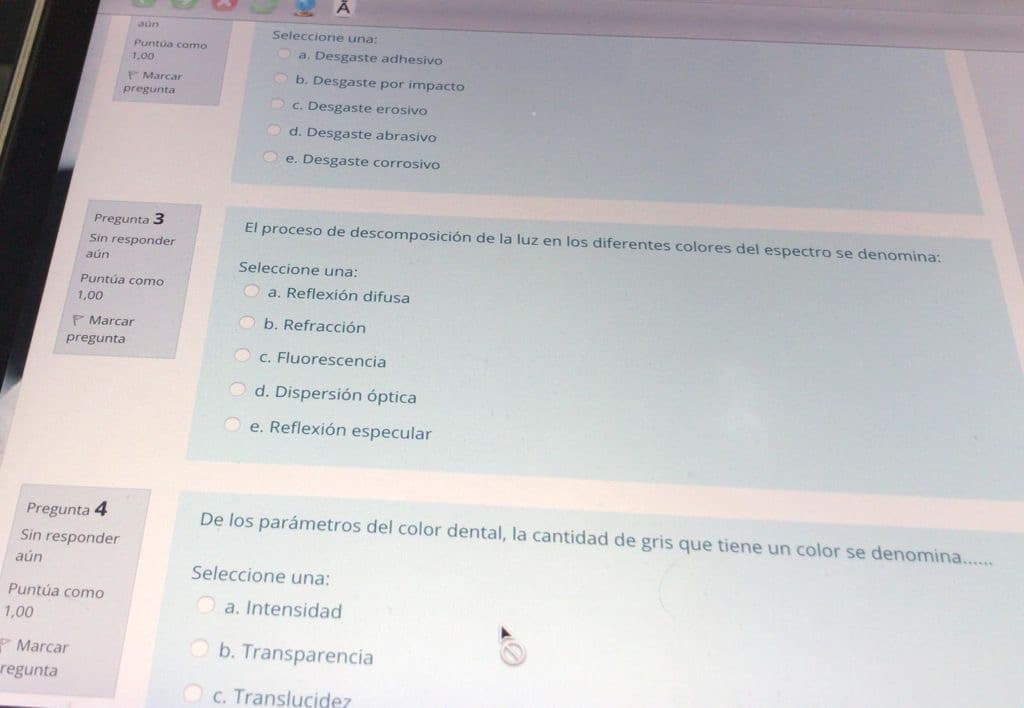
¿Qué término define la cantidad de gris que tiene un color?
#25
Appears 4 times in Test+(Année non identifiée Session non spécifiée, Année non identifiée Session non spécifiée, 2019 Session non spécifiée, 2019 Session non spécifiée)
¿Cuál de las siguientes NO es una propiedad del titanio usado en odontología?
#26
Appears 4 times in Test+(Année non identifiée Session non spécifiée, Année non identifiée Session non spécifiée, 2019 Session non spécifiée, 2019 Session non spécifiée)
En las propiedades ópticas de los materiales, ¿cómo reconocemos la cantidad de gris que tiene un color?
#27
Appears 4 times in Test+(Année non identifiée Session non spécifiée, Année non identifiée Session non spécifiée, 2019 Session non spécifiée, 2019 Session non spécifiée)
La temperatura bucal en condiciones ambientales oscila entre:
#28
Appears 4 times in Test+(Année non identifiée Session non spécifiée, Année non identifiée Session non spécifiée, 2019 Session non spécifiée, 2019 Session non spécifiée)
¿Cuál es el activador químico de las resinas acrílicas autopolimerizables?
#29
Appears 3 times in Test+(Année non identifiée Session non spécifiée, 2019 Session non spécifiée, 2019 Session non spécifiée)
¿Cuál es la función del Trietilenglicol dimetacrilato (TEGDMA) en los materiales dentales?
#30
Appears 2 times in Test+(2024 Session non spécifiée, 2024 Session non spécifiée)
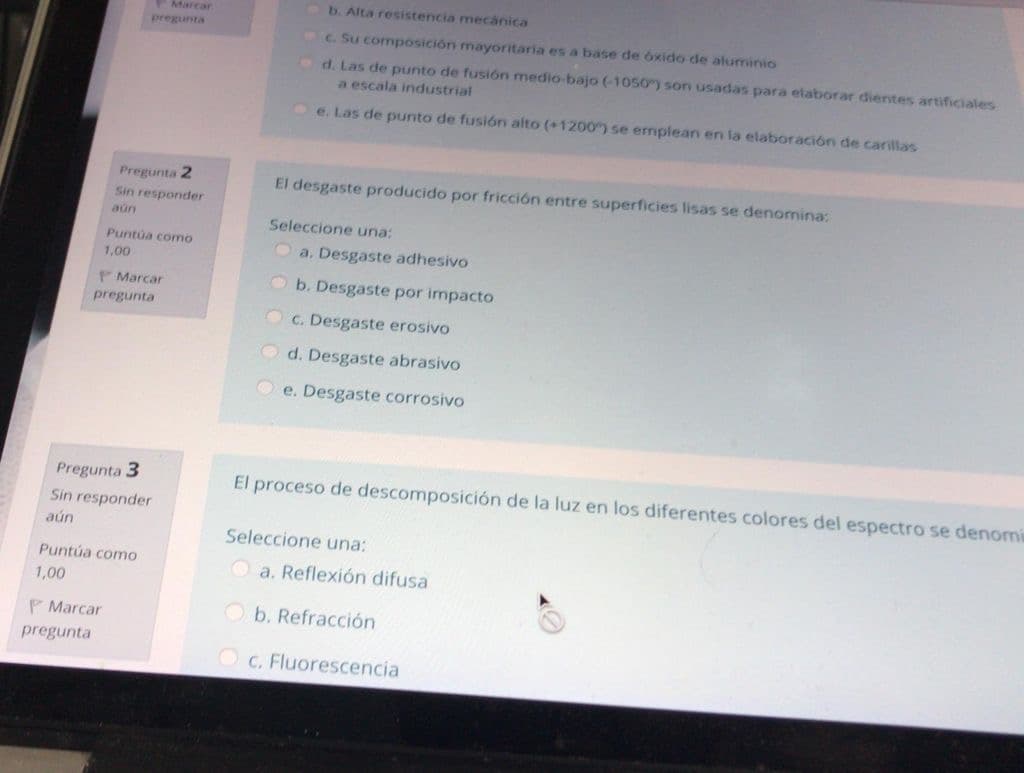
El desgaste que se produce por fricción de superficies lisas se llama:
#31First semester
Señale la respuesta FALSA respecto al Óxido de zinc-eugenol:
#32First semester
En la pasivación de los metales se produce el fenómeno de:
#33
Within what temperature range can hot or cold foods cause oral cavity temperatures to fluctuate?
a. Vary from 0 to 70 °Cb. Vary from 10 to 60 °Cc. Vary from 20 to 80 °Cd. Vary from 25 to 50 °C
#34
What is the typical average physiological value of resting salivary pH?
a. Around 4.0b. Around 5.5c. Around 6.6d. Around 7.5
#35
Which category of organizations oversees testing and quality control of biomaterials before commercialization?
a. Unregulated independent clinical laboratoriesb. Exclusively national professional associationsc. International organizations such as the ADA, ISO, and FDId. Private dental practices responsible for commercialization
#36
Which three broad families of dental materials are classified according to their physicochemical nature?
a. Metals and polymersb. Periodontics, surgery, and prosthodonticsc. Polymers, ceramics, and metalsd. Prophylaxis, orthodontics, and periodontics
#37
What do in vitro laboratory evaluation tests simulate when assessing dental materials?
a. Clinical trialsb. Conditions of the oral cavityc. Biological interactions in human patientsd. Clinical outcomes obtained in vivo
#38
What is the first rational decision-making step when selecting a dental material?
a. Compare propertiesb. Study available materialsc. Analyze the problemd. Select a family of materials
#39
Which two major clinical advantages are conferred by the radiopacity of a dental filling biomaterial?
a. Dimensional stability and thermal resistanceb. Simple handling and straightforward storage requirementsc. Stain resistance and acceptable organoleptic propertiesd. Radiographic monitoring and localization in case of accidental ingestion
#40
Which harmful consequences are prevented by thorough restoration polishing that minimizes plaque accumulation?
a. Toxicity and allergic reactionb. Corrosion and mechanical fatiguec. Staining and dietary pigmentationd. Fracture and mechanical wear
#41
For which therapeutic objective is controlled solubility desired in glass ionomer cements?
a. Fluoride releaseb. Radiopacityc. Stain resistanced. Dimensional stability
#42
Which four fundamental biological requirements define the biocompatibility of a dental material?
a. Non-soluble, non-fragile, non-deformable, and non-stainableb. Non-toxic, non-irritating, non-allergenic, and non-carcinogenicc. Non-rough, non-unstable, non-opaque, and inexpensived. Non-corrosive, non-brittle, non-soluble, and non-unstable
#43
In which category of individuals are alternating oral cycles of moisture and dryness particularly pronounced?
a. Individuals who breathe through the mouthb. Individuals with an oral infectionc. Individuals with an oral woundd. Individuals presenting with fever
#44
Which psychological or endocrine disorders can cause an alkalization of oral pH?
a. Infections, wounds, fever, diabetes, and acidic foodsb. Wounds, diabetes, and acidic foodsc. Fever, infections, and acidic substancesd. Anxiety, depression, and thyroid disorders
#45
Which general or local pathological conditions cause an acidification of oral pH?
a. Anxiety and depressionb. Infections, wounds, fever, and diabetesc. Alkaline substances, anxiety, and depressiond. Depression, alkali, and thyroid disorders
#46
Which major physiological and physicochemical roles are fulfilled by saliva within the oral cavity?
a. Solvent, abrasive, electrical insulator, nutritive, coloring agent, and salivary bufferb. Solvent, desiccant, thermal conductor, allergen, and bufferc. Lubricant, adhesive, thermal insulator, carcinogen, and bufferd. Solvent, lubricant, electrical conductor, antimicrobial agent, and buffer
#47
Which dental discipline studies the composition, properties, manipulation, and clinical applications of dental products?
a. The science of dental materialsb. The biology of dental tissuesc. The physiology of the oral cavityd. The regulation of dental products
#48
Which rheological property allows a gel to liquefy under shear or vibration before solidifying at rest?
a. Fluidityb. Viscosityc. Thixotropyd. Imbibition
#49
Which thermal phenomenon characterizes the temperature lag between liquefaction and gelation in hydrocolloids?
a. Thixotropyb. Imbibitionc. Viscosityd. Hysteresis
#50
Which dimensional phenomenon corresponds to the spontaneous shrinkage of a gel with exudation and liquid loss?
a. Imbibitionb. Syneresisc. Hysteresisd. Viscosity
#51
Which metallic elements display a hexagonal close-packed crystal lattice structure?
a. Cadmium, mercury, and zincb. Gold, silver, copper, platinum, and ironc. Iron, platinum, and silverd. Iron, copper, and platinum
#52
Which primary chemical bond type results from the combination of a metal and a non-metal?
a. The ionic bondb. The covalent bondc. The metallic bondd. The hydrogen bond
#53
Which primary chemical bond type characterizes the assembly of polymer macromolecules?
a. The covalent bondb. The metallic bondc. The hydrogen bondd. The Van der Waals bond
#54
Which weak intermolecular interactions constitute physicochemical secondary bonds?
a. High-energy ionic forces and chemical covalent bondsb. Van der Waals forces and hydrogen bondsc. Metallic bonds and ionic bondsd. Ionic forces and metallic bonds
#55
How is a solid structure characterized by a random, disordered arrangement of its constituent atoms described?
a. A geometric, systematic, and perfectly ordered crystalline structureb. A systematic unit cell structurec. A non-crystalline amorphous structured. A hexagonal close-packed structure
#56
Which remarkable mechanical property is conferred by the body-centered cubic crystalline arrangement?
a. Ductilityb. Malleabilityc. Mechanical resistanced. Brittleness
#57
Which physical phenomenon corresponds to the swelling of a gel due to liquid absorption from its surroundings?
a. Syneresisb. Imbibitionc. Thixotropyd. Hysteresis
#58
How does the viscosity of a fluid or impression material change when its temperature rises?
a. It increases as the temperature increasesb. It increases and then decreases with temperaturec. It decreases and then increases with temperatured. It decreases as the temperature increases
#59
Which structural isomer of polyisoprene constitutes the natural polymer of gutta-percha?
a. Cis-isopreneb. Trigonal quartzc. Amorphous fused silicad. Trans-isoprene
#60
How is the property of distinct chemical substances crystallizing within the identical geometric system defined?
a. Polymorphismb. Allotropyc. Isomorphismd. Thixotropy
#61
Which plastic deformation properties characterize metals with a face-centered cubic structure such as gold?
a. Resistance and brittlenessb. Cohesion and viscosityc. Fluidity and thixotropyd. Ductility and malleability
#62
How is the existence of several distinct crystalline forms of a single pure chemical element designated?
a. Allotropyb. Polymorphismc. Isomorphismd. Isomerism
#63
What is the term for the ability of a single chemical compound to crystallize into distinct crystal systems?
a. Allotropyb. Polymorphismc. Isomorphismd. Crystallinity
#64
Which physical law states the direct proportionality between stress and strain within the elastic regime?
a. Young's modulusb. The fatigue lawc. Specific resistanced. Hooke's law
#65
How is a permanent dimensional change retained by a material after load removal designated?
a. A reversible elastic deformationb. An immediate mechanical failurec. A transient thermal deformationd. An irreversible plastic deformation
#66
Which mechanical property measures the total energy absorbed by a material up to its elastic limit?
a. Toughnessb. Ductilityc. Resilienced. Malleability
#67
Which mechanical property reflects the capacity of a material to withstand extensive plastic deformation before fracture?
a. Resilienceb. Ductilityc. Elasticityd. Toughness
#68
Which progressive failure phenomenon occurs under repeated cyclic stresses of subcritical intensity?
a. Mechanical fatigueb. Cohesive failurec. Elastic deformationd. Galvanic corrosion
#69
Which surface mechanical property corresponds to the resistance offered against indentation or penetration?
a. Toughnessb. Ductilityc. Hardnessd. Rigidity
#70
Which superficial wear mechanism occurs during direct mutual friction between two smooth surfaces?
a. The abrasive mechanismb. The corrosive mechanismc. The erosive mechanismd. The adhesive mechanism
#71
Which mode of mechanical wear appears during friction between a rough surface and a smooth surface?
a. The adhesive modeb. The abrasive modec. The corrosive moded. The impact mode
#72
Which type of physical wear is induced by the dynamic impact of abrasive particles propelled by a fluid or air stream?
a. The adhesive modeb. The erosive modec. The abrasive moded. The corrosive mode
#73
Which thermal property corresponds to the amount of heat required to raise the temperature of one gram of matter by 1 °C?
a. Specific heatb. Thermal conductivityc. Thermal expansiond. Melting temperature
#74
Which mathematical relationship links the volumetric thermal expansion coefficient to the linear coefficient?
a. Double the linear coefficientb. Triple the linear coefficientc. Half of the linear coefficientd. Quadruple the linear coefficient
#75
Which major clinical complication is caused by a significant mismatch in thermal expansion between tooth and filling?
a. Protective passivation of the interfaceb. Microleakage at the interfacec. Fluorescence of the restorationd. Increased mechanical resilience
#76
Which physical property represents the mathematical inverse of electrical conductivity?
a. Thermal conductivityb. Surface tensionc. Linear expansiond. Electrical resistivity
#77
Which metals in the electromotive series behave as anodes highly susceptible to corrosion?
a. Cathodic metalsb. Anodic metalsc. Passivated metalsd. Ductile metals
#78
Which colorimetric parameter corresponds to the amount of gray determining how light or dark a color appears?
a. Value or lightnessb. Chroma or saturationc. Opacity or absorptiond. Translucency or diffusion
#79
Which optical dimension of color quantifies its strength or degree of purity relative to white?
a. Chroma or saturationb. Value or lightnessc. Opacity or absorptiond. Translucency or diffusion
#80
Which optical property characterizes a medium that partially transmits light, such as dental enamel?
a. Transparencyb. Refractionc. Translucencyd. Dispersion
#81
Which optical phenomenon causes two colors identical under one light to appear different under another light source?
a. Fluorescenceb. Refractionc. Metamerismd. Translucency
#82
Which optical property corresponds to the spontaneous re-emission of visible light when exposed to ultraviolet radiation?
a. Metamerismb. Refractionc. Fluorescenced. Transparency
#83
What is the term for the available time window in which a practitioner can manipulate and insert a dental material?
a. Working timeb. Mixing timec. Initial setting timed. Final setting time
#84
Which chronological stage of the reaction corresponds to the attainment of final hardness and ultimate strength?
a. Working timeb. Mixing timec. Final setting timed. Initial setting time
#85
Which thermodynamic characteristic accompanies the setting of acrylic resins during polymerization?
a. An endothermic reactionb. An athermal reactionc. A mechanical contractiond. An exothermic reaction
#86
How does increasing the surface energy of a solid substrate influence its adhesive bonding ability?
a. The material adheres more readilyb. The material adheres less readilyc. The material becomes less reactived. The material becomes more hydrophobic
#87
Which intermolecular liquid force drives mercury droplets to spontaneously adopt a spherical configuration?
a. Surface energyb. Capillarityc. Wettabilityd. Surface tension
#88
Which geometric angular parameter directly dictates the wettability of a liquid on a solid surface?
a. Surface energyb. Surface tensionc. Viscosityd. Contact angle
#89
Which protective surface phenomenon halts deep corrosion through the spontaneous formation of an oxide layer?
a. Metal adsorptionb. Metal capillarityc. Metal passivationd. Metal fluorescence
#90
Which type of mechanical failure is characterized by crack propagation occurring entirely within the material bulk?
a. A cohesive fractureb. An adhesive fracturec. An elastic ruptured. Superficial erosion
#91
Which chemical conditioning surface treatment creates mechanical micro-retentions within dental tissues?
a. Metallic passivationb. Salivary capillarityc. Acid etchingd. Rotary abrasion
#92
What type of activator initiates the polymerization of self-curing resins without external energy input?
a. Thermal activatorsb. Chemical activatorsc. Chemical inhibitorsd. Mechanical catalysts
#93
What term describes the generation of oral microcurrents caused by the coexistence of two dissimilar metals?
a. Oral capillarityb. Oral galvanismc. Salivary adsorptiond. Dental metamerism
#94
How is the temperature range of solid-to-liquid transition characteristic of metal alloys and waxes termed?
a. A setting temperatureb. A working timec. A melting ranged. A proportional limit
#95
Which physical quantity measures the ability of a restorative filling material to transmit heat flux?
a. Electrical conductivityb. Surface tensionc. Thermal conductivityd. Volumetric expansion
#96
How is the mechanical stress exerted by two convergent forces acting along the identical straight line named?
a. A tensile forceb. A compressive forcec. A shear forced. A gliding force
#97
How is a material capable of undergoing plastic deformation under tensile forces without rupturing described?
a. A malleable materialb. A brittle materialc. An elastic materiald. A ductile material
#98
Which opposite stress regimes coexist simultaneously within a component subjected to bending forces?
a. Concave tension and convex compressionb. Concave compression and convex tensionc. Compression on both opposing surfacesd. Concave shear and convex sliding
#99
Which mechanical stress results from two equal and opposite force couples acting around a shared axis?
a. Torsionb. Flexionc. Glidingd. Compression
#100
Which sector of the dental arch physiologically experiences the most intense occlusal masticatory forces?
a. The molar regionb. The incisor regionc. The cervical regiond. The anterior region
#101
Which physical parameter defined by the ratio of stress to strain quantifies the stiffness of a material?
a. Material resilienceb. Young's elastic modulusc. Material ductilityd. Material malleability
#102
Which clinical prosthetic situation represents an absolute contraindication to using dental alginate?
a. Orthodontic study modelsb. Impressions for fixed prosthesesc. Removable partial denturesd. Complete removable dentures
#103
To which family of aqueous hydrocolloids does dental impression alginate belong?
Which chemical component acts as a setting retarder in dental alginate powder?
a. Calcium sulfateb. Sodium phosphatec. Diatomaceous earthd. Potassium alginate
#105
Which mineral filler derived from fossil algae accounts for approximately 70 % of alginate powder by weight?
a. Diatomaceous earthb. Calcium sulfatec. Sodium phosphated. Colloidal silica
#106
Which two opposing fluid-exchange phenomena render alginate impressions particularly dimensionally unstable?
a. Contraction and expansionb. Adsorption and capillarityc. Hydrophilicity and hydrophobicityd. Syneresis and imbibition
#107
Within what maximum timeframe and under what humidity conditions must an alginate impression be poured?
a. In less than 4 h at 100 % humidityb. In less than 1 h at 50 % humidityc. In less than 1 h at 100 % humidityd. In less than 24 h at 75 % humidity
#108
Which rheological characteristic enables dental alginate to record oral mucous membranes without depressing them?
a. A mucocompressive viscosityb. A mucostatic viscosityc. A mucostatic rigidityd. A thermoplastic fluidity
#109
Which noble metal acts as the reaction catalyst in addition-curing silicones?
a. Tin octoateb. Lead dioxidec. Calcium sulfated. Platinum salt
#110
Which cross-linked polymer without by-products is formed during the setting of addition silicones?
a. Ethylene oxide copolymerb. Polyvinylsiloxanec. Alginated. Cross-linked polysulfide
#111
For what maximum duration does an addition silicone impression maintain dimensional stability in dry air?
a. Up to 7 days in dry airb. Up to 1 hour in dry airc. Up to 2 days in dry aird. Up to 30 days in dry air
#112
Which water-interaction characteristic mandates an entirely dry operative field when using condensation silicones?
a. A highly hydrophilic behaviorb. A marked water absorptionc. A rapid aqueous imbibitiond. A highly hydrophobic behavior
#113
Which functional chemical groups characterize the polymeric prepolymer chains of polysulfides?
a. Thiol groupsb. Hydride groupsc. Vinyl groupsd. Ethylene groups
#114
Which heavy metal oxide contained in the catalyst paste activates the setting of polysulfides?
a. Tin octoateb. Lead dioxidec. Platinum saltd. Titanium dioxide
#115
Which impression materials exhibit physical setting dependent on temperature change?
a. Waxes and agarb. Waxes and alginatesc. Polyethers and agard. Plasters and waxes
#116
Which two major clinical indications justify using polyethers due to their high rigidity after setting?
a. Removable dentures and opposing archesb. Root canals and study castsc. Fixed prostheses and implant prosthesesd. Complete dentures and opposing impressions
#117
Which insoluble salt forms the final gel network during the setting reaction of dental alginate?
a. Sodium alginateb. Potassium alginatec. Calcium sulfated. Calcium alginate
#118
What is the recommended temperature range for mixing water when preparing dental alginate?
a. From 25 to 30 °Cb. From 30 to 36 °Cc. From 18 to 24 °Cd. From 12 to 17 °C
#119
Which chemical contaminant found in latex gloves inhibits the polymerization of addition silicones?
a. Catalyst platinumb. Paste leadc. Filler silicad. Latex sulfur
#120
Which intrinsic water affinity property favorably distinguishes polyethers from traditional silicones?
a. High hydrophobicityb. Low wettabilityc. Good hydrophilicityd. Marked syneresis
#121
Which volatile by-product released during the setting of condensation silicones causes dimensional contraction?
a. A volatile alcoholb. A water moleculec. A sulfur compoundd. An aromatic ester
#122
Which metallic accelerator participates in the setting reaction of condensation silicones?
a. Platinum saltb. Tin octoatec. Lead dioxided. Calcium sulfate
#123
Which outstanding mechanical property favorably distinguishes polysulfides from other dental elastomers?
a. Great rigidity after settingb. High dimensional stabilityc. High tear resistanced. Low deformation under pressure
#124
Which precision casting method utilizes carving wax patterns that are thermally eliminated during heating?
a. The lost-wax techniqueb. The simple impression techniquec. The double impression techniqued. The occlusal mounting technique
#125
How is the tendency of heated wax to deform under light stresses or its own weight defined?
a. Distortion or memoryb. Flow or creepc. Melting or liquefactiond. Rigidity or toughness
#126
For what thermal purpose is microcrystalline wax incorporated into dental wax mixtures?
a. To increase their melting temperatureb. To lower their melting temperaturec. To reduce their surface hardnessd. To increase their room-temperature brittleness
#127
Which animal-derived wax forms the primary component of dental sticky wax used in laboratories?
a. Carnauba waxb. Candelilla waxc. Beeswaxd. Paraffin wax
#128
Which plant wax hardens paraffin while displaying a lower melting point than carnauba?
a. Carnauba waxb. Microcrystalline waxc. Paraffin waxd. Candelilla wax
#129
Which mineral wax derived from petroleum distillation melts between 48 and 70 °C?
a. Beeswaxb. Paraffin waxc. Carnauba waxd. Candelilla wax
#130
Which fundamental thermal behavior defines the waxes utilized in dental procedures?
What primary role do occlusal registration bite waxes perform during prosthetic fabrication?
a. Fabricate gypsum master castsb. Block out embrasures prior to impressionsc. Mount casts correctly on the articulatord. Model metallic prosthetic frameworks
#132
Which hard plant wax derived from palm leaves raises the melting temperature and restricts the intraoral flow of paraffin?
a. Candelilla waxb. Carnauba waxc. Beeswaxd. Paraffin wax
#133
What is the typical breadth of the melting range observed in a blended dental wax mixture?
a. A range of 1 to 4 °Cb. A range of 35 to 50 °Cc. A range of 65 to 90 °Cd. A range of 5 to 30 °C
#134
What is the term for the thermal threshold at which dental wax softens and becomes workable without melting?
a. Complete melting temperatureb. Maximum flow temperaturec. Volumetric expansion temperatured. Glass transition temperature
#135
What is the maximum order of magnitude for the thermal expansion coefficient of dental waxes?
a. A coefficient up to 6 %b. A coefficient up to 1 %c. A coefficient up to 12 %d. A coefficient up to 30 %
#136
Which organic chemical activator triggers initiator breakdown in self-curing acrylic resins?
a. Benzoyl peroxideb. Methyl methacrylatec. Ethylene glycol dimethacrylated. Dimethyl-p-toluidine
#137
Which chemical compound found in the powder releases free radicals to initiate acrylic polymerization?
a. Benzoyl peroxideb. Methyl methacrylatec. Barium sulfated. Hydroquinone
#138
Which optional cross-linking agent forms covalent bridges between PMMA chains to enhance mechanical properties?
a. Ethylene glycol dimethacrylateb. Methyl methacrylatec. Benzoyl peroxided. Stabilizing hydroquinone
#139
Which liquid chemical constituent stabilizes the monomer by inhibiting spontaneous polymerization during storage?
a. Methyl methacrylateb. Benzoyl peroxidec. Hydroquinoned. Dimethyl-p-toluidine
#140
Which heavy mineral salt can be incorporated into acrylic resin to make it radiopaque?
a. Benzoyl peroxideb. Barium sulfatec. Calcium sulfated. Methyl methacrylate
#141
Which characteristic thermal behavior accompanies the breaking of double bonds during acrylic polymerization?
a. An endothermic reactionb. An exothermic reactionc. An athermal reactiond. A glass transition
#142
At what minimum temperature does thermal decomposition of benzoyl peroxide activate in heat-cured resins?
a. Heat at 20 °Cb. Heat at 60 °Cc. Heat at 40 °Cd. Heat at 100 °C
#143
Which unreacted, unpolymerized molecule is responsible for mucosal irritation and allergic reactions to acrylics?
a. Residual monomerb. Cross-linked polymerc. Residual inhibitord. Acrylic pigment
#144
Which undesirable long-term optical outcome is caused by tertiary amines in self-curing acrylic resins?
a. A long-lasting increase in translucencyb. An improvement in chromatic stabilityc. An improvement in aesthetic polishd. Decreased color stability
#145
Which technical or physical factors promote the occurrence of porosity within cured acrylic resin?
a. Water sorption or high pressureb. Low volatility or closed containerc. Monomer evaporation or insufficient pressured. Glass transition or radiopacity
#146
Which intraoral physical phenomenon partially compensates for the polymerization shrinkage of acrylic dentures?
a. Water sorptionb. Thermal expansionc. Glass transitiond. Volumetric contraction
#147
What approximate volumetric shrinkage percentage do acrylic resins undergo during polymerization setting?
a. A contraction of about 1 %b. A contraction of about 12 %c. A contraction of about 6 %d. A contraction of about 20 %
#148
Which handling phase corresponds to a non-sticky, pliable dough that constitutes the clinical working time?
a. The sandy phaseb. The adhesive phasec. The initiation phased. The plastic phase
#149
During which mixing phase of dental acrylic resin does the material exhibit a sticky, stringy consistency?
a. The sandy phaseb. The adhesive phasec. The plastic phased. The activation phase
#150
What is the term for the polymerization phase characterized by rapid chain growth via monomer additions?
a. Activationb. Terminationc. Propagationd. Cross-linking
#151
What average particle size characterized the early conventional macrofilled composites?
a. From 5 to 30 µmb. From 0.6 to 1 µmc. From 0.1 to 0.4 µmd. From 30 to 60 µm
#152
What biomechanical benefit does the low elastic modulus of a flowable composite placed as a cavity liner provide?
a. Significantly increasing internal contraction stressb. Dissipating polymerization contraction stressc. Reducing cavity wall adaptationd. Limiting marginal seal integrity
#153
What submicron silica particle size forms the dispersed phase of microfilled composites?
a. Silica from 0.6 to 1 µmb. Silica from 0.04 to 0.4 µmc. Silica from 0.4 to 5 µmd. Silica from 30 to 60 µm
#154
What proportion of additional water do microfilled composites absorb compared to macrofilled ones?
a. One to two times more waterb. Five to six times more waterc. Ten to twelve times more waterd. Two to four times more water
#155
What atomic property of mineral filler elements determines the radiopacity of a dental composite?
a. Low atomic numberb. High molecular weightc. High atomic numberd. Very fine particle size
#156
What major surface drawbacks resulted from the poor polishability of macrofilled composites?
a. Roughness, plaque accumulation, and stainingb. Hardness, gloss, and radiopacityc. Fluidity, adhesion, and hydrophilicityd. Elasticity, toughness, and resilience
#157
What indirect mechanism explains pulp cytotoxicity when marginal sealing of composite fails?
a. Diffusion of organic pigments through dentinal tubulesb. Diffusion of silane agent into the dental pulpc. Migration of mineral fillers into inner dentind. Passage of bacteria and toxins through tubules
#158
Which classic photoinitiator has a peak light absorption at 470 nm in dental composites?
a. Phenylpropanedioneb. Benzoyl peroxidec. Camphorquinoned. Dimethyl-p-toluidine
#159
Toward which cardinal point does the shrinkage vector of a composite preferentially direct during light curing?
a. Toward the center of the materialb. Toward the organic resin matrixc. Toward the curing light sourced. Toward the deep cavity floor
#160
Toward which area does the volumetric setting shrinkage of a self-curing resin occur?
a. Toward the curing light sourceb. Toward the mineral filler particlesc. Toward the outer occlusal surfaced. Toward the center of the material
#161
What thin unpolymerized surface film persists upon contact with ambient air on composite surfaces?
a. The silane-loaded layerb. The oxygen-inhibited layerc. The pigment-enriched layerd. The heat-crosslinked layer
#162
What were the two major physicochemical drawbacks of the early acrylic restorative resins introduced in 1947?
a. Low polymerization shrinkage and low coefficient of thermal expansionb. High water sorption and low formulation viscosityc. High surface hardness and excellent clinical wear resistanced. Polymerization shrinkage and high thermal expansion coefficient
#163
What minimum volume threshold of inorganic fillers is required to withstand posterior occlusal forces durably?
What type of composite exhibits tensile and compressive mechanical strength equivalent to natural dentin?
a. Microfilled compositesb. Macrofilled compositesc. Flowable compositesd. Hybrid composites
#165
What maximum thickness limit of light penetration requires applying light-cured composites in successive layers?
a. A curing depth limited to 2 mmb. A curing depth limited to 0.5 mmc. A curing depth limited to 1 mmd. A curing depth limited to 4 mm
#166
What decisive kinetic advantage distinguishes self-curing composites in deep cavity restorations?
a. A curing depth limited to 2 mmb. Shrinkage directed toward lightc. A depth of polymerization without limitd. A prolonged clinical working time
#167
Which clinical cavity situation represents the preferred indication for packable composites?
a. Class I cavitiesb. Class II cavitiesc. Class III cavitiesd. Class IV cavities
#168
Which lightly filled resin formulation is recommended for preventive pit and fissure sealing?
a. A lightly filled and fluid Bis-GMA resinb. An UDMA resin heavily loaded with mineral particlesc. A TEGMA resin without inorganic filler loadingd. An EGDMA resin with high formulation viscosity
#169
In what percentage of situations do composite restorations induce a moderate pulp inflammatory response?
a. In 10% of casesb. In 25% of casesc. In 50% of casesd. In 75% of cases
#170
Which intermediate product is essential to ensure durable retention of composite resin to enamel and dentin?
a. A filler silane agentb. An organic pigmentc. A barium glass fillerd. An adhesive system
#171
What practical adhesive role does the oxygen-inhibited layer fulfill between two successive composite increments?
a. Bonding successive layers without adhesiveb. Separating successive layers without fracturec. Polymerizing layers without any light sourced. Providing radiopacity to successive layers
#172
What average percentage of carbon-carbon double bonds actually reacts during composite polymerization?
a. Generally 20 to 30%b. Generally 40 to 50%c. Generally 60 to 70%d. Generally 95 to 100%
#173
What is the average setting volumetric shrinkage range observed in dental composite resins?
a. From 0.5 to 1%b. From 2 to 4%c. From 5 to 7%d. From 8 to 10%
#174
Which composite formulation offers superior long-term chromatic stability?
What particle size was selected in optimized microhybrids to enhance aesthetic performance?
a. Particles of 0.04 µmb. Particles of 0.8 µmc. Particles of 0.4 µmd. Particles of 30 µm
#176
What proportions and particle types are typically combined in conventional hybrid composite formulations?
a. 85% particles and 15% microfillersb. 60% particles and 40% microfillersc. 70% particles and 30% microfillersd. 15% particles and 85% microfillers
#177
Which monomer synthesized in 1962 by Raphael Bowen constitutes the major historical matrix of composite resins?
a. The UDMA resinb. The TEGMA resinc. The EGDMA resind. The Bis-GMA resin
#178
How does the incorporation of inorganic fillers modify the coefficient of thermal expansion and the shrinkage of a composite?
a. Increase in thermal expansion and shrinkageb. Decrease in thermal expansion and increase in shrinkagec. Stabilization of thermal expansion and shrinkaged. Decrease in thermal expansion and shrinkage
#179
Which high molecular weight monomer was introduced by Foster and Walker in 1974 as an alternative to Bis-GMA?
a. TEGMA or triethylene glycol methacrylateb. UDMA or urethane dimethacrylatec. MMA or methyl methacrylated. Bis-MA or bisphenol A-methacrylate
#180
Which low viscosity fluid monomer is incorporated as a major diluent to facilitate the addition of mineral fillers?
a. TEGMA or triethylene glycol methacrylateb. UDMA or urethane dimethacrylatec. EGDMA or ethylene glycol dimethacrylated. Bis-MA or bisphenol A-methacrylate
#181
What prominent aesthetic clinical advantage justifies the use of microfilled composites in the anterior sector?
a. Low shrinkage through reduced matrixb. Excellent aesthetics through easy polishabilityc. High strength through large particlesd. Excellent adaptation through high fluidity
#182
Which alternative photoinitiator for very light shades exhibits peak absorption sensitivity at 410 nm?
a. Camphorquinoneb. Phenylpropanedionec. Benzoyl peroxided. Dimethyl-p-toluidine
#183
Which organosilicon coupling agent provides the chemical bond between inorganic filler particles and the organic matrix?
a. The peroxide initiatorb. The organic pigmentc. The TEGMA regulatord. The bifunctional silane
#184
What ratio compares the coefficient of thermal expansion of composites to that of natural dental tissues?
a. From 0.5 to 1 time dental tissuesb. From 2 to 6 times dental tissuesc. From 7 to 10 times dental tissuesd. From 12 to 16 times dental tissues
#185
What minimum weight percentage of inorganic fillers characterizes packable composites?
a. Less than 40% by weightb. From 40 to 60% by weightc. More than 80% by weightd. From 65 to 75% by weight
#186
What reduced proportion of ceramic filler characterizes the formulation of flowable composites?
a. A filler loading of 40 to 60%b. A filler loading of 10 to 30%c. A filler loading of 65 to 75%d. A filler loading of 80 to 85%
#187
For what duration should orthophosphoric acid be applied to dentin during a total-etch procedure?
a. For 15 to 20 secondsb. For 20 to 30 secondsc. For 5 to 15 secondsd. For 1 to 5 seconds
#188
What modified tissue interpenetration structure does self-etch adhesive form over the smear layer?
a. A hybroid layerb. A hybrid layerc. A hydrophobic resin layerd. A collapsed collagen layer
#189
By what factor is enamel surface energy multiplied after etching with orthophosphoric acid?
a. Multiplied by 1b. Multiplied by 3c. Multiplied by 2d. Multiplied by 4
#190
What major drawback on intact enamel does using self-etch adhesives without prior etching present?
a. Superior enamel etching depthb. Inferior enamel etching performancec. Total dentin smear layer removald. Elevated postoperative sensitivity
#191
What major clinical advantage reducing postoperative discomfort do self-etch systems provide?
a. Superior enamel etchingb. Complete dentin smear layer removalc. Significantly superior clinical versatilityd. Lower risk of postoperative sensitivity
#192
Which adhesive systems combine the etching, priming, and bonding steps into a single rinse-free formulation?
a. Multi-component systemsb. Single-component systemsc. Total-etch adhesive systemsd. Self-etching adhesive systems
#193
What structural effect do smear layer modifiers produce on dentinal tubule lumens?
a. Complete dissolution closing the tubulesb. Dehydration of collagen without tubule openingc. Dentin tubule occlusiond. Partial dissolution opening the tubules
#194
Which clinician was the first in 1987 to advocate applying a strong acid onto dentin?
a. Buonocore in 1955b. Fusayama in 1987c. Fusayama in 1992d. Nakabayashi in 1987
#195
What deleterious physical consequence does excessive air drying of etched dentin produce?
a. Collapse of collagen fibersb. Maximal opening of dentinal tubulesc. Complete dissolution of smear layerd. Immediate curing of hydrophilic resins
#196
Which chemical agents are capable of causing complete dissolution of the dentin smear layer?
a. Orthophosphoric acid and oxalic acidb. Citric acid and ferric chloridec. EDTA and nitric acidd. Polyacrylic acid and camphorquinone
#197
What packaging characteristic defines 5th generation total-etch adhesive systems?
a. Primer and bonding combined in one bottleb. Etchant and primer combined in one bottlec. Etchant and bonding combined in one bottled. Primer separate from bonding in two bottles
#198
What is the primary structural objective of acid etching on the enamel surface?
a. Creating micromechanical retentionsb. Removing the dentin smear layerc. Causing collapse of collagen fibersd. Increasing adhesive resin viscosity
#199
Which adhesive solvent exhibits versatile tolerance allowing application to either wet or dry dentin?
a. Acetoneb. Waterc. Camphorquinoned. Ethanol
#200
Which researcher and year defined the fundamental concept of the dentin hybrid layer?
a. Buonocore in 1955b. Nakabayashi in 1987c. Buonocore in 1992d. Nakabayashi in 1992
#201
What orthophosphoric acid concentration and application duration are recommended on enamel?
a. 10% orthophosphoric acid for 15 secondsb. 37% orthophosphoric acid for 15 secondsc. 10% orthophosphoric acid for 30 secondsd. 37% orthophosphoric acid for 30 seconds
#202
What characteristic visual appearance confirms achieving optimal enamel etching after drying?
a. Translucent appearanceb. A bluish glassy appearancec. A chalky white appearanced. A yellowish dull appearance
#203
What nature of resin monomers forms the primer to wet the moist collagen network?
a. Hydrophilic resinsb. Hydrophobic resinsc. Bifunctional monomersd. Insoluble mineral fillers
#204
Which author and year mark the landmark description of enamel acid etching with orthophosphoric acid?
a. Buonocore in 1955b. Fusayama in 1987c. Nakabayashi in 1992d. Buonocore in 1987
#205
What immediate clinical procedure is mandatory in case of saliva contamination of etched enamel?
a. Repeating the etch for 10 secondsb. Rinsing the surface for 10 secondsc. Repeating the etch for 30 secondsd. Applying the primer for 10 seconds
#206
What tissue and microbial components form the dentin smear layer during cavity instrumentation?
a. Hydrophilic resin, collagen, water, and camphorquinoneb. Hydroxyapatite, hydrophobic resin, amine, and peroxidec. Dentin debris, collagen, odontoblastic processes, and bacteriad. Intact dentin, enamel, resin, and solvent
#207
Which volatile organic solvent present in some primers is specifically adapted for wet dentin bonding?
a. Waterb. Ethanolc. Acetoned. Camphorquinone
#208
What type of resin forms the intermediate bonding agent placed onto primed surfaces?
a. A hydrophilic resinb. A hydrophobic resinc. An acidic monomerd. A photosensitive initiator
#209
What acid and single concentration are used in the total-etch adhesive technique?
Why is etching acid typically packaged in the form of a colored viscous gel?
a. Accelerating bonding polymerizationb. Facilitating placement and visual controlc. Removing residual dentinal smear debrisd. Increasing etchant acid concentration
#211
Which functional monomer possesses both hydrophilic and hydrophobic chemical groups in universal adhesives?
a. Hydrophilic HEMA monomerb. Hydrophobic Bis-GMA monomerc. Hydrophobic UDMA monomerd. Bifunctional MDP monomer
#212
What is the chemical composition of the liquid of zinc phosphate cement?
a. Aqueous orthophosphoric acid solution at 50 to 60%b. Aqueous orthophosphoric acid solution concentrated from 10 to 20%c. Aqueous orthophosphoric acid solution at 37%d. Aqueous orthophosphoric acid solution at 90%
#213
What mixing technique is recommended to retard setting and extend the working time of zinc phosphate?
a. Dispensing onto a hot slabb. Dispensing onto a cold glass slabc. Dispensing into a prepared cavityd. Dispensing onto a set cement layer
#214
What powder-to-liquid weight ratio is generally recommended to achieve a base consistency?
a. A ratio of 1 to 3.5 for a baseb. A ratio of 3.5 to 1 for fluid lutingc. A ratio of 3.5 to 1 for a based. A ratio of 5 to 1 for fluid luting
#215
What type of adhesion binds zinc phosphate cement to tooth structures and prostheses?
a. A chemical adhesionb. A thermal adhesionc. A mechanical adhesiond. An electrical adhesion
#216
What dimensional characteristic of the cement line optimizes retention and sealing with zinc phosphate?
a. A thick cement filmb. A soluble cement filmc. A porous cement filmd. A thin cement film
#217
What acidic pH value does zinc phosphate cement exhibit approximately 3 minutes after mixing begins?
a. A pH of approximately 3.5b. A pH of approximately 1.5c. A pH of approximately 5.5d. A pH of approximately 7.0
#218
Which metal oxides primarily compose the powder of zinc phosphate cement?
a. Zinc oxide with magnesium oxideb. Magnesium oxide with orthophosphoric acidc. Zinc oxide with orthophosphoric acidd. Zinc oxide combined with an aqueous solution
#219
What functional distinction separates a protective cavity liner from an intermediate base under a restoration?
a. Tubule sealing and toxic substance limitation for the baseb. Thermal and electrical insulation and mechanical support for the basec. Easily removable closure and root canal sealing for the based. Periodontal healing and tissue regeneration for the base
#220
What intraoral physicochemical behavior represents the primary drawback of zinc phosphate during luting?
a. High initial mechanical strength after mixingb. Excessive chemical adhesion to tooth tissuec. Superior aesthetic appearance in the mouthd. High solubility in the oral environment
#221
How should the powder be spatulated into the liquid during zinc phosphate preparation?
a. In a single increment without vigorous spatulationb. In small increments spatulated widely and vigorouslyc. In large increments with brief spatulationd. In small increments with localized spatulation
#222
Within what timeframe does the pH of zinc phosphate cement reach complete neutrality after placement?
a. In 3 minutesb. In 5 minutesc. In 24 hoursd. In 48 hours
#223
How should the powder be incorporated into the liquid during polycarboxylate preparation?
a. Slowly in small incrementsb. Quickly in small incrementsc. After the liquid in equal incrementsd. Quickly in large increments
#224
What are the weight components of the zinc polycarboxylate cement powder?
a. 10% zinc oxide and 90% magnesium oxideb. 90% zinc oxide and 10% magnesium oxidec. 80% zinc oxide and 20% magnesium oxided. 50% zinc oxide and 50% magnesium oxide
#225
Which liquid component provides polycarboxylate cement with chemical adhesion and biological tolerance?
What specific type of adhesive bond does polycarboxylate cement establish with calcified tooth structures?
a. Mechanical adhesion to dental tooth structuresb. Chemical adhesion to dental tooth structuresc. Chemical adhesion to the glass mixing slabd. Mechanical bond to stainless steel alloys
#227
What powder-to-liquid ratio is recommended for mixing zinc polycarboxylate cement?
a. A ratio of 1.5 to 1b. A ratio of 1 to 1.5c. A ratio of 3.5 to 1d. A ratio of 2.5 to 1
#228
What is the recommended spatulation duration when mixing polycarboxylate cement?
a. From 10 to 20 secondsb. From 30 to 40 secondsc. From 50 to 60 secondsd. From 1 to 2 minutes
#229
What kinetic time constraint characterizes the manipulation of zinc polycarboxylate cement?
a. A very long clinical working timeb. A prolonged spatulation durationc. The very short clinical working timed. A working time identical to phosphate
#230
To which metallic alloy does zinc polycarboxylate cement bond with remarkable strength?
a. To stainless steelb. To magnesium oxidec. To the glass slabd. To calcified tooth structures
#231
How does the pulp biological tolerance of polycarboxylate compare to zinc phosphate?
a. Less aggressive toward the pulpb. More aggressive toward the pulpc. Equally aggressive toward the pulpd. Less tolerated by tooth structures
#232
How do the mechanical properties of polycarboxylate compare to those of zinc phosphate?
a. Superior to zinc phosphateb. Superior to stainless steelc. Inferior to zinc phosphated. Identical to tooth structures
#233
What approximate percentage of fluoride is incorporated into the aluminosilicate glass powder of glass ionomer cements?
a. Around 10% fluorideb. Around 20% fluoridec. Around 40% fluorided. Around 60% fluoride
#234
Which two independent chemical reactions drive the hardening of resin-modified glass ionomer cements?
a. Resin photopolymerization and an acid-base reactionb. Glass photopolymerization and a sintering reactionc. Resin dissolution and an acid-base reactiond. Polyacid photopolymerization and metal fusion
#235
Which historical precursor materials were combined to create glass ionomer cements?
a. Polycarboxylate powder and silicate cement liquidb. Silicate cement powder and composite liquidc. Silicate cement powder and polycarboxylate liquidd. Composite powder and silicate cement liquid
#236
Which formulation modification characterizes so-called anhydrous glass ionomer cements?
a. Freeze-dried resins inside the powderb. Freeze-dried photoinitiators inside the powderc. Polyacids removed from the powderd. Freeze-dried acids inside the powder
#237
What is the name of reinforced glass ionomer cements that incorporate metal particles fused to glass via sintering?
a. Compomersb. Cermetsc. Ionositesd. Anhydrous glass ionomers
#238
Which chemical mechanism allows glass ionomer cement to bond directly to dental hard tissues without an adhesive system?
a. Mechanical adhesion via resins and collagenb. Thermal adhesion via alumina and calciumc. Mechanical adhesion via tubules and resind. Chemical adhesion via carboxyl groups and calcium
#239
Which major biological and preventative property results from the continuous ion release of glass ionomer cements?
a. A cariostatic effect via fluoride releaseb. A thermal effect via calcium releasec. A mechanical effect via collagen released. A cariostatic effect via resin release
#240
What is the name of the hybrid material class resulting from the combination of composite resins and polyacids?
a. Compomers or ionositesb. Cermets or reinforced glass ionomersc. Anhydrous or protective cementsd. Conventional or endodontic glass ionomers
#241
Which fundamental chemical reaction governs the setting of conventional glass ionomer cements?
a. A photopolymerization reactionb. A sintering reactionc. An acid-base reactiond. A reaction between resins
#242
Which organic acid is specifically added as a setting accelerator to the liquid of glass ionomer cements?
What is the characteristic setting kinetics of a setting calcium hydroxide cement?
a. Setting in 20 to 25 minutes then 12 hoursb. Setting in 30 to 40 minutes then 2 hoursc. Final setting in 5 hoursd. Setting in 2 to 5 minutes then 24 hours
#244
What is the characteristic pH range of pure calcium hydroxide powder?
a. A pH of 9b. A pH of 7.4 to 7.8 measured in exposed powderc. A pH of 12.4 to 12.8 for the pure powderd. A pH of 3.5 to 5.5 measured in exposed powder
#245
Which biological phenomenon is induced by calcium hydroxide during an uncontaminated accidental pulp exposure under 1 mm?
a. Resin closure with the formation of a cavity baseb. Calcific closure with the formation of a dentine bridgec. Acid neutralization with the formation of calcium carbonated. Rapid setting with the formation of a hardening cement
#246
How is the remarkable antimicrobial efficacy of calcium hydroxide explained?
a. Acidity reinforces infectious acidosis and blocks pulpal calcificationb. Alkalinity neutralizes acidosis and destroys the majority of microorganismsc. Photopolymerization lowers pH and dissolves microorganismsd. Solubility increases acidosis and prevents final setting
#247
For which major clinical applications is non-setting pure calcium hydroxide in aqueous solution indicated?
a. For pulpectomy and temporary cementation of prepared prosthesesb. For apexification and direct pulp cappingc. For radiopacity and sensitivity reductiond. For thermal insulation and final setting
#248
What risk is incurred if calcium hydroxide powder is exposed to ambient atmospheric carbon dioxide?
a. It can become light-cured and lose its therapeutic valueb. It can become an activator and lose its therapeutic valuec. It can turn back into calcium carbonate and lose its therapeutic valued. It can revert into a catalyst paste and lose its therapeutic value
#249
Which compound is sometimes added to setting calcium hydroxide to provide radiopacity on radiographic examination?
a. Barium sulfateb. Ethyl toluenesulfonamidec. Carbon dioxided. Calcium
#250
Which constituent can be incorporated into setting calcium hydroxide cements to act as an antiseptic agent?
a. Ethyl toluenesulfonamide as an antisepticb. Calcium carbonate as an antisepticc. Carbon dioxide as an antisepticd. Setting activator as an antiseptic
#251
What are the mechanical characteristics of calcium hydroxide cement compared to other dental cements?
a. High tensile and compressive strengthb. Low strength paired with a high modulus of elasticityc. Superior strength compared to other dental cementsd. Low tensile and compressive strength
#252
What is the primary benefit of calcium hydroxide in endodontics when managing a necrotic tooth?
a. It helps control apical exudate in cases of necrosisb. It increases the mechanical strength of the necrotic toothc. It provides temporary sealing of the necrotic toothd. It reduces sensitivity
#253
What direct beneficial effect does ZOE cement produce when applied to freshly cut dentine?
a. A sedative effect on freshly cut dentineb. Chemical adhesionc. A polymerizing effect on freshly cut dentined. A contracting effect on freshly cut dentine
#254
Why has the use of ZOE cement for root canal obturation in endodontics been largely abandoned?
a. Its pH is acidicb. It bonds chemically to periodontal tissuesc. It displays excessively high mechanical strengthd. It is irritating to periodontal tissues
#255
To which clinical impression scenario is zinc oxide-eugenol impression paste strictly restricted?
a. To dentate areas without undercutsb. To edentulous areas with undercutsc. To edentulous areas without undercutsd. To root canals without irritation
#256
Which luting application can exceptionally be considered with the reinforced IRM formulation?
a. It can serve for temporary lutingb. It can serve for composite restorationsc. It can serve for permanent lutingd. It can serve for contemporary root canal sealing
#257
What is the characteristic pH value of zinc oxide-eugenol cement?
a. An alkaline pH between 9.6 and 11b. A near-neutral pH between 6.6 and 8c. A near-neutral pH between 4.6 and 6d. A highly alkaline pH between 12.6 and 14
#258
What type of bonding to dental tissues does zinc oxide-eugenol cement exhibit?
a. Chemical adhesion without mechanical bondingb. Mechanical adhesion without chemical bondingc. Chemical and mechanical adhesiond. Thermal adhesion without mechanical bonding
#259
What major incompatibility does eugenol exhibit with aesthetic restorative materials?
a. Interference with composite polymerizationb. A decrease in composite solubilityc. Improved chemical adhesion of compositesd. An increase in composite mechanical strength
#260
What is the nature of the setting reaction of conventional zinc oxide-eugenol cement?
a. A rapid acid-base reaction with heat releaseb. A slow acid-base reaction without heat releasec. A rapid acid-base reaction with high shrinkaged. A thermal polymerization reaction without shrinkage
#261
What is the typical plant origin of the eugenol used in the formulation of ZOE cement?
a. An extract of clove oilb. An extract of silica and aluminac. An extract of reinforced polymersd. An extract of ethoxybenzoic acid
#262
Which additives improve mechanical properties in reinforced ZOE formulations?
a. Silica, eugenol, zinc oxide, or polymersb. Silica, alumina, polymers, or clove oilc. Silica, alumina, composites, or zinc phosphated. Silica, alumina, polymers, or ethoxybenzoic acid
#263
Which thermal processing method is employed to manufacture dental stone or alpha-hemihydrate?
a. Dry heating in an open vessel between 120 and 130 °Cb. Wet heating inside an autoclave between 110 and 120 °Cc. Wet heating inside an autoclave between 120 and 130 °Cd. Dry heating inside an autoclave between 120 and 130 °C
#264
Which granular morphology characterizes the powder of improved high-strength dental stone?
a. Very regular, dense, and small particlesb. Regular, porous, and bulky particlesc. Irregular, dense, and small particlesd. Very regular, porous, and large particles
#265
According to the ADA classification, what is the specific clinical application of type IV dental stone?
a. Taking impressionsb. Fabricating individual diesc. Pouring diagnostic study castsd. Pouring master working models
#266
What thermal phenomenon accompanies the crystallization of calcium sulfate hemihydrate into dihydrate?
a. An endothermic reaction absorbing heat from the mixb. A reaction releasing water without heatc. A reaction that progressively cools the modeld. An exothermic reaction releasing heat
#267
How long should manual circular spatulation of gypsum paste last in the mixing bowl?
a. For 1 to 1.5 minutes using circular movementsb. For 30 seconds using circular movementsc. For 3 minutes using circular movementsd. For 10 minutes using circular movements
#268
What average volume of gauging water is required to mix 100 g of improved high-strength dental stone?
a. Around 18.6 mL for improved dental stoneb. Around 30 mL for improved dental stonec. Around 25 mL for improved dental stoned. Around 45 mL for improved dental stone
#269
Approximately how much working time does the operator have to pour the dental impression?
a. Around 3 minutes to pour into the impressionb. Around 5 minutes to pour into the impressionc. Around 10 minutes to pour into the impressiond. Around 30 minutes to pour into the impression
#270
At which concentration does sodium chloride effectively accelerate the setting of gypsum?
a. At more than 5 % sodium chlorideb. At less than 20 % sodium chloridec. At less than 5 % sodium chlorided. At more than 20 % sodium chloride
#271
At which concentration does sodium chloride conversely become a setting retarder of dental gypsum?
a. At more than 12 % sodium chlorideb. At more than 20 % sodium chloridec. At less than 20 % sodium chlorided. At less than 5 % sodium chloride
#272
How does the mechanical strength of set dental gypsum compare in compression versus tension?
a. More resistant in tension than in compressionb. Equally resistant in tension and in compressionc. Resistant in compression with zero tensile strengthd. More resistant in compression than in tension
#273
What method prevents dissolution erosion when immersing or trimming a dental gypsum cast?
a. Using a solution saturated with calcium sulfateb. Using unsaturated cold tap waterc. Using a saturated calcium chloride solutiond. Immersing the cast into mixing water
#274
Which calcination method yields plaster of Paris or beta-hemihydrate?
a. Calcination in an open vessel between 120 and 130 °Cb. Boiling in calcium chloride solution between 110 and 120 °Cc. Calcination in a closed vessel between 110 and 120 °Cd. Calcination in an open vessel between 110 and 120 °C
#275
What is the natural mineral composition of gypsum prior to any thermal treatment?
In what type of container must dental gypsum powder be stored to prevent its deterioration?
a. In a humid and airtight containerb. In a dry and airtight containerc. In a humid and open containerd. In a flexible bowl exposed to air
#277
How is high-strength improved dental stone with maximal surface hardness manufactured?
a. Calcination in an open vessel without calcium chlorideb. Wet heating inside an autoclave without calcium chloridec. Boiling in an autoclave within calcium chloride solutiond. Calcination inside an autoclave within sodium sulfate solution
#278
Which fundamental mechanical limitation restricts the clinical use of conventional dental porcelains?
a. Low compressive strengthb. Low tensile strengthc. High strain under stressd. High thermal conductivity
#279
What function do borates serve when added as fluxes to dental ceramic powder?
a. Fluxes increasing the firing temperatureb. Fluxes lowering the firing temperaturec. Fillers enhancing enamel translucencyd. Pigments providing tooth shades
#280
Which basic component acts as a binder within the composition of dental porcelains?
a. Alumina serving as a binderb. Borates serving as bindersc. Aluminium silicates serving as bindersd. Metallic oxides serving as binders
#281
What direct mechanical effect does the ceramization phase exert on material fracture toughness?
a. Crack propagation is acceleratedb. Crack propagation is arrestedc. Crack propagation remains unaffectedd. Porosity formation is promoted
#282
Where are the three-dimensional scan data transmitted for coping fabrication within the Procera system?
a. Onto the digital screen to define preparation marginsb. To the dental operatory to contour the coping manuallyc. Into the autoclave to sinter the copingd. To the industrial milling center to fabricate the coping
#283
Which outstanding flexural properties characterize zirconium oxide used in dental CAD/CAM systems?
a. Flexural strength below 900 MPa and low fracture toughnessb. Compressive strength exceeding 900 MPa without toughnessc. Tensile strength exceeding 900 MPa and low hardnessd. Flexural strength exceeding 900 MPa and high fracture toughness
#284
What increase in flexural and tensile strength is gained from glass infiltration following core sintering?
a. Two to three times less resistantb. Two to three times more resistantc. Four to five times more resistantd. Two to three times more deformable
#285
Which glass infiltration powder is applied onto the porous aluminous coping in the refractory die technique?
Which commercial systems illustrate the class of glass-ceramics processed via casting or hot-pressing?
a. Cerapearl and All-Ceramb. Hi-Ceram and In-Ceramc. Procera All Ceram and Lavad. IPS-Empress and Dicor
#287
Which microstructural transformation occurs during the devitrification or ceramization process?
a. Transforms amorphous structure into crystalline structureb. Transforms crystalline structure into amorphous structurec. Transforms porous structure into metallic structured. Transforms feldspathic structure into aluminous structure
#288
Upon which chemical interaction does intimate bonding between ceramic and metallic frameworks rely?
a. Between silica and metal undercutsb. Between alumina and porcelain pigmentsc. Between alloy metals and porcelain oxygend. Between borates and alloy surfaces
#289
Which thermal condition must dental porcelain meet during metal-ceramic restoration procedures?
a. Melting range higher than that of the alloyb. Melting range lower than that of the alloyc. Melting range identical to that of the alloyd. Melting range independent of that of the alloy
#290
Which clinical characteristics contrast aluminous porcelain with conventional feldspathic porcelain?
a. Less resistant but more aestheticb. More resistant and more aestheticc. Less resistant and less aestheticd. More resistant but less aesthetic
#291
To which specific prosthetic application are high-fusing feldspathic porcelains (above 1200 °C) restricted?
a. Industrially manufacturing artificial teethb. Directly fabricating inlays and veneersc. Fabricating all-ceramic metal-free copingsd. Veneering milled zirconia copings
#292
What is the average feldspar content in conventional feldspathic dental porcelain?
a. Around 60 % feldsparb. Around 25 % feldsparc. Around 50 % feldspard. Around 99.9 % feldspar
#293
Which remarkable thermal match prevents cracking during intraoral thermal shocks?
a. Coefficient of thermal expansion matching metalsb. Coefficient of thermal expansion higher than the toothc. Coefficient of thermal expansion close to that of the toothd. Coefficient of thermal expansion lower than the tooth
#294
Which major biological advantage distinguishes dental ceramics from other prosthetic restorative materials?
a. Most biocompatible materials in dentistryb. Most radiopaque materials in dentistryc. Most deformable materials in dentistryd. Most thermally conductive materials in dentistry
#295
What is the primary objective of applying a final glaze layer over the fired ceramic surface?
a. Seals pores and provides a smooth finishb. Provides tooth colorationc. Forms the most opaque layerd. Strengthens the chemical bond with metal
#296
Which base metals exhibit outstanding tissue tolerance owing to spontaneous surface passivation?
a. Nickel and cobaltb. Mercury and berylliumc. Cadmium and silverd. Chromium and titanium
#297
Which cold-forming manufacturing process produces thin metallic sheets or plates?
a. Wire drawing by tension through ductilityb. Burnishing by polishing to impart lusterc. Rolling by compression through malleabilityd. Electrodeposition within an electrolytic bath
#298
To which specific prosthetic application is pure copper dedicated within the dental laboratory?
a. For working master casts in the laboratoryb. For direct gold foil fillings in the laboratoryc. For endodontic points in the laboratoryd. For dental implants and prostheses in the laboratory
#299
Which fundamental chemical property strictly defines the nobility of a dental metal?
a. They command an exceptionally high market priceb. They are chemically highly reactivec. They are chemically inactive or minimally reactived. They are abundant in nature
#300
Which electrochemical behavior do metals exhibit when placed in an electrolytic medium?
a. They gain peripheral electrons and become anionsb. They give up peripheral electrons and become cationsc. They give up peripheral protons and become anionsd. They retain their electrons and remain electrically neutral
#301
Which density threshold conventionally defines the category of light metals such as titanium?
a. Light metals under 0.1 g/cm³b. Light metals under 500 g/cm³c. Light metals under 5 g/cm³d. Light metals between 5 and 10 g/cm³
#302
Which crystalline lattice arrangement facilitates easy plastic deformation in metals like gold or nickel?
a. A hexagonal close-packed latticeb. A simple cubic lattice without centered facesc. An amorphous non-crystalline latticed. A face-centered cubic lattice
#303
Which modification of mechanical properties does a quenching heat treatment induce in an alloy?
a. It decreases hardness and strengthb. It increases hardness and strengthc. It reduces hardness while increasing brittlenessd. It increases ductility and malleability
#304
Which packaging presentation in the dental office minimizes occupational exposure risks when handling mercury?
a. The pre-dosed capsuleb. Mercury poured into an open dishc. An ingot cooled at room temperatured. An electrolytic mercury bath
#305
Upon which physical mechanism does autogenous welding, also known as spot welding, rely?
a. Melting of a third filler metal between partsb. Superficial melting of the two metals in direct contactc. Plastic deformation of both metals by compressiond. Electrolytic deposition interposed between metals
#306
What metallurgical benefit is achieved through an annealing heat treatment with controlled slow cooling?
a. Eliminate internal stresses and reduce brittlenessb. Increase internal residual stresses and brittlenessc. Increase hardness through sudden quenchingd. Produce a metallic coating via electrodeposition
#307
Which mechanical property governs the ability of a metal to be drawn into thin wire under tension without fracturing?
a. Ductility under tensionb. Hardness by immersionc. Passivation by oxidationd. Toughness by centrifugation
#308
Which medical term designates the clinical syndrome of systemic poisoning caused by mercury?
a. Electrical discharge machining as mercury intoxicationb. Passivation as mercury intoxicationc. Ceramization as mercury intoxicationd. Hydrargyrism as mercury intoxication
#309
Which metal used in dental alloys is the most frequent cause of contact allergic sensitization?
a. Chromium as the leading allergenb. Nickel as the leading allergenc. Cobalt as the leading allergend. Mercury as the leading allergen
#310
Which thermal cooling condition leads to the formation of a superstructure or ordered solid solution?
a. Very slow cooling producing regular spatial orderb. Abrupt quenching producing regular spatial orderc. Rapid melting producing an interstitial latticed. Cold quenching producing a disordered structure
#311
What are the two fundamental components of a single-phase metallic solid solution called?
a. A minority solvent and a majority soluteb. Two majority solvents without solutec. A majority eutectic and a minority solventd. A majority solvent and a minority solute
#312
How do atoms of similar sizes arrange themselves within a disordered substitutional solid solution?
a. Substituted randomly within the crystalline latticeb. Ordered regularly within the crystalline latticec. Lodged between atoms without replacing themd. Clustered within grains of the majority metal
#313
Where do small atomic radius atoms lodge within an interstitial solid solution?
a. In place of the small metal atomsb. Within separated grains of the small metalc. On the surface of the larger metald. Within the lattice of the larger metal
#314
How do the mechanical properties of a solid solution evolve compared to those of its individual pure constituent metals?
a. Less hard, less ductile, and less strongb. Harder but less ductile and less strongc. Harder, more ductile, and more resistantd. Less hard but more ductile and strong
#315
What thermal melting characteristic distinguishes a metallic solid solution from a pure metal?
a. A melting range rather than a single melting pointb. A single melting point rather than a melting rangec. Two discrete points rather than a melting ranged. A range identical to constituent melting temperatures
#316
How many distinct structural phases coexist in a eutectic alloy that is completely insoluble in the solid state?
a. Closely associated in a single phaseb. Closely associated in two phasesc. Closely associated in three phasesd. Dissolved uniformly into a single phase
#317
What thermal relationship exists between the melting temperature of a eutectic mixture and its pure constituent metals?
a. A melting point higher than each constituentb. A melting point lower than each pure metalc. A melting point equal to each constituentd. Two discrete melting points specific to constituents
#318
What are the few specific applications of eutectic metallic alloys in clinical dentistry?
a. For solders and silver amalgamsb. For implants and surgical instrumentsc. For gold foil fillings and dowelsd. For veneers and inlays
#319
Which geometric and stoichiometric rule governs the internal organization of an intermetallic compound?
a. A variable proportion and a random positionb. A fixed proportion and a specific positionc. A fixed proportion and a random positiond. Two fixed proportions across two separated phases
#320
How do the castability and plasticity of an alloy change compared to its pure constituent metals?
a. Cast with difficulty but gain ductility and malleabilityb. Cast easily and gain ductility and malleabilityc. Cast more easily but lose ductility and malleabilityd. Cast with difficulty and lose hardness and strength
#321
Which alloy formulations possess the unique property of being workable in a plastic state at room temperature?
a. Based on mercury or galliumb. Based on chromium or nickelc. Based on silver or palladiumd. Based on cobalt or titanium
#322
Which primary chemical characteristic imparts outstanding intraoral biocompatibility to dental gold?
a. It corrodes rapidlyb. It resists corrosionc. It passivates via chromiumd. It resists deformation
#323
Which advantageous physical property closely aligns dental gold with natural tooth structures?
a. Expansion coefficient higher than dental tissuesb. Thermal conductivity close to dental tissuesc. Expansion coefficient close to dental tissuesd. Hardness close to dental tissues
#324
Which physical mechanism permitted cohesion between gold foils during direct gold foil placement?
a. Thermal melting of the foilsb. Cold welding of the metalc. Pure mechanical retention of foilsd. Superficial passivation of the metal
#325
How do nobility and mechanical hardness evolve across dental gold casting alloys from type I to type IV?
a. Nobility increases while hardness decreasesb. Nobility and hardness increase simultaneouslyc. Nobility decreases while hardness increasesd. Nobility increases while hardness remains stable
#326
What effect does adding silver produce on the characteristics of a precious gold dental alloy?
a. Enhances hardness and lightens the yellow hueb. Decreases hardness and deepens the yellow huec. Enhances hardness and deepens the yellow hued. Increases melting temperature and deepens yellow hue
#327
What metallurgical role does the addition of platinum play in gold-based dental casting alloys?
a. Decreases strength and melting temperatureb. Increases strength but lowers melting temperaturec. Decreases strength but raises melting temperatured. Increases strength and melting temperature
#328
Why is palladium frequently employed as an advantageous economic substitute for platinum?
a. Improves strength and prevents tarnish pigmentationb. Decreases strength and promotes tarnish pigmentationc. Lowers melting point and imparts a reddish tintd. Eliminates impurities and decreases hardness
#329
What aesthetic and chemical drawback results from adding excessive copper to a dental casting alloy?
a. Increases chemical stability with a white shadeb. Increases chemical stability with a reddish tintc. Prevents tarnish pigmentation with a yellow hued. Decreases chemical stability with a reddish tint
#330
What functional role do zinc, indium, and tin fulfill during the melting and casting of dental gold alloys?
a. They increase impurities during meltingb. They impart a reddish tint to the alloyc. They eliminate contaminants during meltingd. They increase conductivity after casting
#331
What are the respective proportions of the major components within a base metal nickel-chromium alloy?
a. Nickel 10 to 25 % and chromium 60 to 80 %b. Nickel 60 to 80 % and chromium 10 to 25 %c. Nickel 35 to 65 % and chromium 20 to 35 %d. Nickel 10 to 12 % and chromium 60 to 80 %
#332
Through which electrochemical mechanism do nickel-chromium alloys resist intraoral salivary corrosion?
a. Through the allergenic potential of nickelb. Through the low density of nickelc. Through the passivating effect of chromiumd. Through the thermal conductivity of chromium
#333
What are the respective concentrations of cobalt and chromium in a dental cobalt-chromium base metal alloy?
a. Cobalt 20 to 35 % and chromium 35 to 65 %b. Cobalt 60 to 80 % and chromium 10 to 25 %c. Cobalt 10 to 12 % and chromium 60 to 80 %d. Cobalt 35 to 65 % and chromium 20 to 35 %
#334
Which absolute thermal requirement is imposed upon the metallic coping of a metal-ceramic crown?
a. A melting temperature lower than that of the ceramicb. A melting temperature identical to that of the ceramicc. A melting temperature independent of that of the ceramicd. A melting temperature higher than that of the ceramic
#335
For which demanding prosthetic restorations are hard and extra-hard type III and IV gold alloys utilized?
a. For crowns, veneers, and endodontic pointsb. For crowns, bridges, and removable partial denture frameworksc. For frameworks, solders, and silver amalgamsd. For prostheses, orthodontic brackets, and gold foil restorations
#336
What phenomenon gives titanium its high resistance to corrosion?
a. A porous surface layer due to carbonb. A passive surface layer due to oxygenc. An active surface layer due to chromiumd. A protective connective layer due to oxygen
#337
At what temperature does the allotropic transformation of titanium into body-centered cubic beta phase occur?
a. An allotropic transformation above 500 °Cb. An allotropic transformation above 1400 °Cc. An allotropic transformation above 1430 °Cd. An allotropic transformation above 882 °C
#338
What is the measured specific mass or density of titanium?
a. A light density of 15 g/cm³b. A light density of 4.5 g/cm³c. A light density of 17 g/cm³d. A light density of 40 g/cm³
#339
What ductility value do stainless steels display for the fabrication of wires or files?
a. A ductility of 0.1 to 1%b. A ductility of 10 to 25%c. A ductility of 15 to 17%d. A ductility of 40 to 60%
#340
What is the characteristic melting temperature range of stainless steels?
a. A melting range of 1050 to 1350 °Cb. A melting range of 1250 to 1400 °Cc. A melting range of 1400 to 1430 °Cd. A melting range of 40 to 60 °C
#341
What molecular structure is involved in the direct bond between bone and the titanium implant?
a. A layer of connective tissue without proteoglycansb. An oxide layer with connective tissuec. A layer of proteoglycans without connective tissued. A layer of collagen directly separating the bone
#342
What is the approximate density value of dental stainless steels?
a. A density of approximately 8 g/cm³b. A density of approximately 15 g/cm³c. A density of approximately 17 g/cm³d. A density of approximately 40 g/cm³
#343
In which clinical situation are martensitic stainless steels preferentially used?
a. When corrosion resistance takes precedence over mechanical strengthb. When malleability takes precedence over mechanical strengthc. When mechanical strength takes precedence over corrosion resistanced. When thermal conductivity takes precedence over mechanical strength
#344
What is the typical composition of classic 18-8 austenitic stainless steel?
a. 8% chromium and 18% nickelb. 18% chromium and 0.25% nickelc. 18% nickel and 2% chromiumd. 18% chromium and 8% nickel
#345
What maximum percentage of carbon does steel contain to prevent embrittlement?
a. A carbon content below 2%b. A carbon content below 0.2%c. A carbon content below 0.25%d. A carbon content above 2%
#346
What remarkable properties characterize nickel-titanium and beta-titanium alloys?
a. Low resilience, rigidity, and absence of memoryb. Superelasticity, shape memory, and high resiliencec. High hardness, severe corrosion, and low resilienced. Malleability, thermal conductivity, and low elasticity
#347
At what thermal level is the elevated melting point of titanium situated?
a. An elevated melting point at 1770 °Cb. An elevated melting point at 1400 °Cc. An elevated melting point at 1430 °Cd. An elevated melting point at 1200 °C
#348
Which chemical family forms the basis of liquid resins for dental 3D printing?
a. Photopolymerizable lithium disilicatesb. Liquid zirconium oxidesc. Esters of phosphoric acidd. Esters of methacrylic acid
#349
What technical application is reserved for burnout castable resins milled in the laboratory?
a. Intended for staining or glazingb. Intended for impressions or modelingc. Intended for pressing or castingd. Intended for cleaning or polymerization
#350
In which clinical situation are PMMA discs preferentially utilized in digital workflows?
a. Definitive restorations in the posterior zoneb. Permanent bridges extending up to fourteen unitsc. Surgical splints printed from fluid resind. Provisional restorations for complex cases
#351
What mechanical strength value does multilayer zirconia display for posterior regions?
a. A strength of 14 MPab. A strength of 1200 MPac. A strength of 120 MPad. A strength of 12000 MPa
#352
What maximum number of units can a milled zirconia dental bridge span?
a. Bridges up to 14 unitsb. Bridges up to 12 unitsc. Bridges up to 16 unitsd. Bridges up to 1200 units
#353
Which processing step immediately follows the milling of a lithium disilicate framework?
a. Staining, glazing, and firing for 4 to 12 minutesb. Polishing and cementation without additional firingc. Injection or casting during 4 to 12 minutesd. Fixation of acrylic teeth followed by polishing
#354
Which restorations are commonly fabricated from feldspathic ceramic blocks in CAD-CAM?
a. Inlays, veneers, and full-coverage crownsb. Posterior bridges extending up to fourteen unitsc. Long-term provisional restorations for complex casesd. Surgical splints and occlusal night guards
#355
How does CAD-CAM minimize imperfections during prosthetic design?
a. Manual adjustment following fabricationb. Metal casting prior to digitalizationc. Software adjustment prior to fabricationd. Conventional modeling without scanning
#356
Which procedure generates the initial virtual model in a CAD-CAM dental workflow?
a. A conventional impression using elastic materialb. A digital impression using an intraoral scannerc. Direct milling using an extraoral scannerd. 3D printing using burnout castable resin
#357
Which initial solvent cleaning step is applied to 3D printed objects after removal from the build platform?
a. Clean first in an ultrasonic bathb. Clean first with 96% ethanolc. Clean first with 16% ethanold. Polymerize first before washing
#358
Which oral functions are mentioned among the mouth's particular biological conditions?
a. Mastication, swallowing, phonation, and breathingb. Fracture, deformation, wear, and corrosionc. Appearance, odor, taste, and touchd. Prevention, endodontics, orthodontics, and surgery
#359
Which range corresponds to the normally observed oral pH?
a. 0 to 70b. 4 to 8.5c. 32 to 37d. 6.6 to 8.5
#360
Through which route does the oral mucosa mainly absorb substances?
a. The respiratory routeb. The endovascular routec. The sublingual routed. The periodontal route
#361
Which ideal property encompasses resistance to fracture, deformation, and wear?
a. Dimensional stabilityb. Material compatibilityc. Organoleptic qualityd. Mechanical resistance
#362
Which step completes the logical selection of a dental material?
a. Analyze the problemb. List the requirementsc. Study the available materialsd. Choose a family of materials
#363
Which electron behavior characterizes metals?
a. They donate electronsb. They accept electronsc. They arrange electronsd. They isolate electrons
#364
Which primary bond joins metals to form alloys?
a. Ionic bondingb. Metallic bondingc. Covalent bondingd. Hydrogen bonding
#365
Which property of a fluid is the inverse of its viscosity?
a. Flow rateb. Cohesionc. Fluidityd. Thixotropy
#366
What effect does a greater proportion of crystalline component have on the melting range?
a. It narrows the rangeb. It widens the rangec. It increases flowd. It increases distortion
#367
In which areas may waxes for impressions of edentulous regions be used?
a. Areas with embrasuresb. Areas of heavy occlusionc. Areas without undercutsd. Areas with a framework
#368
What distinguishes the properties of synthetic waxes from those of natural waxes?
a. They are variableb. They are identicalc. They are more brittled. They are more adhesive
#369
Which thermal requirement applies to waxes for complete denture baseplates?
a. Melt below oral temperatureb. Soften at room temperaturec. Equal body temperatured. Melt above oral temperature
#370
Which properties do gums and resins give to waxes?
a. Hardness and toughnessb. Fluidity and swellingc. Adhesion and flexibilityd. Strength and opacity
#371
Which wax melts between 65 and 90 °C?
a. Paraffin waxb. Beeswaxc. Carnauba waxd. Microcrystalline wax
#372
Why is it difficult to heat wax uniformly?
a. Its melting point is too preciseb. Its thermal conductivity is lowc. Its molecular weight is highd. Its structure is too crystalline
#373
Which chemical groups are abundant in the hydrocarbon chains of dental waxes?
a. Ester groupsb. Pigment groupsc. Crystalline groupsd. Mineral groups
#374
Which thermal property explains why acrylic resins do not soften in the mouth?
a. Low thermal conductivityb. An exothermic setting reactionc. A high expansion coefficientd. A glass transition at 75 °C
#375
Which monomer is the main component of the liquid in acrylic resins?
a. Methyl methacrylateb. Ethylene glycol dimethacrylatec. Hydroquinoned. Dimethyl-p-toluidine
#376
During which phase does a free radical open the double bond of methyl methacrylate?
a. Activationb. Initiationc. Propagationd. Termination
#377
Which phase begins when the monomer wets the surface of the polymer beads?
a. The adhesive phaseb. The plastic phasec. The sandy phased. The rigid phase
#378
Which property of acrylic resins limits denture weight and makes them easier to wear?
Which restorations can zinc phosphate cement according to its indications?
a. Temporary restorationsb. Fixed prosthesesc. Pits and fissuresd. Periodontal dressings
#380
Which thermal coefficient is sought in an ideal dental cement?
a. Expansion close to that of the toothb. Conductivity close to that of the toothc. Solubility close to that of the toothd. Strength close to that of the tooth
#381
What role do dental cements perform in endodontics?
a. Sealing between gutta-percha and dentineb. Retention of fixed prosthesesc. Protection of pits and fissuresd. Mechanical support of restorations
#382
What is the role of a cement used as a temporary restoration?
a. A mechanical prosthetic unionb. An easily removable closurec. Sealing of the dentinal tubulesd. Thermal insulation of the restoration
#383
Which characteristic accompanies the rapid setting of zinc phosphate?
a. It is mechanicalb. It is aestheticc. It is insulatingd. It is exothermic
#384
What proportion of final strength is reached during the first hour?
a. 50%b. 60%c. 90%d. 75%
#385
What do cements used as dressings promote in surgery and periodontics?
a. Insulation and supportb. Retention and sealingc. Healing and regenerationd. Closure and removal
#386
What is the purpose of sealing pits and fissures?
a. Retaining fixed orthodontic appliancesb. Compensating for temperature changesc. Mechanically supporting a restorationd. Preventing bacteria and caries
#387
For how long should zinc phosphate be spatulated?
a. 3 minutesb. 5 minutesc. 1.5 minutesd. 24 minutes
#388
Which property of zinc polycarboxylate cement is described as poor?
a. Enamel adhesionb. Biological tolerancec. Mechanical propertiesd. Esthetic qualities
#389
On which surface are the powder and liquid of zinc polycarboxylate cement mixed?
a. A glass slabb. An enamel surfacec. A dentin surfaced. A stainless-steel plate
#390
In which medium do GICs show their greatest solubility?
a. In waterb. In airc. In resinsd. In collagen
#391
Which GIC is indicated for fixed prostheses and fixed orthodontic appliances?
a. Luting GICb. Restorative GICc. Protective GICd. Endodontic GIC
Which GIC provides filling and sealing of the root canal?
a. Restorative GICb. Protective GICc. Endodontic GICd. Luting GIC
#394
What proportion of water does the liquid of a conventional GIC contain?
a. Approximately 20%b. 30% to 40%c. 40% to 50%d. 50% to 60%
#395
How does the thermal expansion coefficient of GICs compare with dental tissues?
a. It is much higherb. It is much lowerc. It is similard. It is unstable
#396
Which substance is a photoinitiator in light-cured GICs?
a. Bis-GMAb. Camphorquinonec. TEGDMAd. HEMA
#397
Which thermal behavior accompanies the chemical setting of a conventional GIC?
a. Strongly endothermicb. Slightly exothermicc. Rapidly endothermicd. Thermally variable
#398
Among cements, how do GICs rank esthetically?
a. The least estheticb. Equal to ceramicsc. Equal to compositesd. The most esthetic
#399
Which cement do GICs exceed in strength and hardness?
a. Compositeb. Amalgamc. Ceramicd. Zinc phosphate
#400
When is calcium hydroxide a good thermal insulator?
a. When pH reaches 9.5b. When setting remains initialc. When the powder remains exposedd. When the material has sufficient thickness
#401
What must be applied over pure non-setting calcium hydroxide?
a. A catalyst pasteb. A setting cementc. A radiopaque sulfated. A liquid antiseptic
#402
Which process produces calcium hydroxide powder?
a. Photopolymerization of a pasteb. Calcination of calcium carbonatec. Dissolution of barium sulfated. Activation of polycarboxylic acid
#403
What appearance does calcium hydroxide powder have?
a. White, fine, odorless, and tastelessb. White, thick, odorous, and bitterc. Transparent, fine, odorous, and solubled. Opaque, granular, odorless, and acidic
#404
Since which period has calcium hydroxide been used in dentistry?
a. The 1930sb. The 1950sc. The 1970sd. The 1990s
#405
Which prosthetic use is attributed to calcium hydroxide?
a. Formation of a dentinal bridgeb. Control of apical exudatec. Reduction of cavity hypersensitivityd. Provisional cementation of prostheses
#406
Which pH range characterizes setting formulations?
a. 2-5b. 9-11c. 9.5-12.4d. 12.4-12.8
#407
Which calcium hydroxide formulation is less soluble?
a. The pure aqueous formb. The base-paste formc. The light-cured formd. The catalyst-paste form
#408
Which element does setting calcium hydroxide require?
a. A closed containerb. Pulpal fluidc. An activator of the setting reactiond. A contrast agent
#409
In which form is the setting single paste generally presented?
a. Light-cured single pasteb. Non-setting formulationc. Non-setting aqueous solutiond. Radiopaque liquid preparation
#410
In which type of cavity is a ZOE base discouraged?
a. A temporary cavityb. An insulated cavityc. A deep cavityd. An edentulous cavity
#411
Which unfavourable mechanical property characterises conventional ZOE cement?
a. High contractionb. Low strengthc. Chemical adhesiond. Thermal expansion
#412
Which unfavourable ZOE property facilitates its degradation in a moist environment?
a. High solubilityb. Low contractionc. A good seald. A nearly neutral pH
#413
What consistency should the ideal ZOE mixture have?
a. Fluidb. Rigidc. Viscousd. Soluble
#414
Which component forms the powder of ZOE cement?
a. Magnesium oxideb. Zinc oxidec. Ethoxybenzoic acidd. Diluted eugenol
#415
Why is the eugenol in ZOE cement used in diluted form?
a. It is soluble and antimicrobialb. It is yellow and viscousc. It is toxic and irritatingd. It is rigid and accurate
#416
Which dimensional change accompanies the setting of ZOE cement?
a. Low contractionb. High expansionc. Extensive dissolutiond. Low adhesion
#417
Which favourable biological property does ZOE cement possess?
a. Antimicrobial activityb. Chemical adhesionc. Mechanical strengthd. Composite polymerisation
#418
Which qualities characterise zinc oxide–eugenol impression paste?
a. Flexible and solubleb. Viscous and sedativec. Slow and antimicrobiald. Rigid and accurate
#419
How long can a temporary ZOE restoration remain in place?
a. Several minutesb. Several hoursc. Several daysd. Several months
#420
Which historical use of dental gypsum is no longer practiced today?
a. Making dental impressionsb. Producing study modelsc. Mounting models on an articulatord. Fabricating working dies
#421
According to the ADA classification, what is type II gypsum used for?
a. For dental impressionsb. For study modelsc. For working modelsd. For high-strength dies
#422
What approximate volume of water is needed for 100 g of beta plaster of Paris?
a. About 18.6 mLb. About 25 mLc. About 45 mLd. About 60 mL
#423
Which procedure becomes possible during the initial setting of gypsum?
a. Remove and trim the modelb. Add free water to the mixturec. Cast metal around the waxd. Remove excess gypsum
#424
What effect does proper vibration have on gypsum strength?
a. It dissolves crystals and reduces hardnessb. It removes pores and increases strengthc. It retains water and slows dryingd. It increases porosity and promotes abrasion
#425
What proportion of alumina does a high-fusing porcelain contain?
a. 4%b. 0%c. 25%d. 50%
#426
What is the purpose of low-fusing corrective porcelains?
a. Increase surface porosityb. Provide the dentin shadec. Avoid another complete firingd. Strengthen the framework through oxidation
#427
Through which routes can mercury be absorbed?
a. Inhalation, ingestion, or the cutaneous routeb. Inhalation, corrosion, or passivationc. Ingestion, melting, or centrifugationd. The cutaneous route, welding, or casting
#428
What does electrodeposition deposit on a metal surface?
a. A layer of metalb. A wax patternc. A laser beamd. A high-frequency current
#429
Which metal has a low melting temperature according to the stated classification?
a. Cobaltb. Titaniumc. Mercuryd. Chromium
#430
What is pure silver used for in dentistry?
a. Working modelsb. Endodontic pointsc. Dental implantsd. Gold foil restorations
#431
Which metals are classified as carcinogenic?
a. Mercury and berylliumb. Nickel, chromium, cobalt, and mercuryc. Beryllium, nickel, cadmium, and chromiumd. Gold, platinum, palladium, and silver
#432
Which process shapes metal by blows or pressure against a die?
a. Wire drawingb. Rollingc. Burnishingd. Stamping
#433
Which property of stainless steels enables the production of bands and matrices?
a. Ductilityb. Thermal conductivityc. Corrosion resistanced. Malleability
#434
Which elements accompany iron and carbon in stainless steels?
a. Titanium-aluminium-vanadiumb. Chromium-nickel or chromium-nickel-molybdenumc. Gold-copper or gold-platinumd. Nickel-titanium or beta-titanium
#435
How are dental steels primarily shaped?
a. By cold workingb. By castingc. By laser processingd. By machining
#436
The elastic modulus of titanium is close to that of which structure?
a. Special ceramicb. Austenitic steelc. Type IV gold alloyd. Bone
#437
In which crystalline form does titanium occur before its allotropic transformation?
a. Body-centred cubic betab. Hexagonal alphac. Austenitic 18-8d. Quenched martensitic
#438
Which prosthetic consequence follows from titanium's low coefficient of expansion?
a. Moulding without special equipmentb. An increase in thermal conductivityc. The use of a special ceramicd. Transformation into alpha phase
#439
Why was titanium introduced into medicine and surgery?
a. Its biological behaviour and low costb. Its easy casting and high expansionc. Its high density and malleabilityd. Its thermal conductivity and radiopacity
#440
Which stainless-steel family has lower mechanical and corrosion resistance?
a. Austenitic steelb. Martensitic steelc. Ferritic steeld. 18-8 steel
#441
In which regions does multilayer zirconia respectively meet aesthetic and strength needs?
a. Posterior then anteriorb. Single-unit then completec. Anterior then posteriord. Provisional then definitive
#442
Which cleaning step follows the initial ethanol treatment of 3D-printed parts?
a. Simple polishingb. Further polymerizationc. Thermal glazingd. An ultrasonic bath
#443
What are acrylic resin discs intended to produce in the digital workflow?
a. Aesthetic veneersb. Complete denturesc. Surgical guidesd. Working models
#444
How many VITA and Bleach shades are offered for precolored or multilayer PMMA discs?
a. 16 shadesb. 14 shadesc. 12 shadesd. 4 shades
#445
Which milling material is described as the strongest?
a. Feldspathic ceramicb. Zirconiac. Lithium disilicated. PMMA
#446
Which delays and operations can be reduced by the speed of CAD-CAM?
a. Conventional impressions, shipping, and waitingb. Milling, printing, and bondingc. Characterization, glazing, and firingd. Design, adjustment, and function
#447
Which outcomes improve with digital design followed by machining or printing?
a. Aesthetics, fluorescence, and polishingb. Strength, firing, and glazingc. Impression, modeling, and waitingd. Fit, function, and durability
#448
How is the completed CAD-CAM restoration placed in the mouth?
a. It is characterized or glazedb. It is injected or castc. It is cemented or bondedd. It is polymerized or polished
#449
Which requirements guide the creation of a customized CAD-CAM restoration?
a. Precision, speed, and durabilityb. Functional, anatomical, and aesthetic requirementsc. Milling, glazing, and polishingd. Digitization, modeling, and adjustment
#450
Which devices can manufacture a restoration from a CAD-CAM design file?
a. A milling machine or a 3D printerb. An intraoral scanner or a spatulac. An ultrasonic bath or a milling machined. A 3D printer or an intraoral scanner
#451
What is the usual ambient temperature of the mouth?
a. 0–70 °Cb. 4–8.5 °Cc. 32–37 °Cd. 6.6–8.5 °C
#452
Which characteristics are organoleptic qualities of a dental material?
a. Fracture, deformation, and wearb. Appearance, odor, taste, touch, and soundc. Temperature, pH, and solubilityd. Nature, structure, technique, and handling
#453
Which factors determine the biocompatibility of a dental material?
a. Price, storage, and polishingb. Wear, solubility, and strength assessed in the laboratoryc. Temperature, pH, and salivad. Material, tissue, technique, and handling
#454
When can marketing follow an in vivo evaluation?
a. After simulating one propertyb. After storage under special conditionsc. After comparing the available familiesd. After reasonable use and acceptable results
#455
Which step follows problem analysis when selecting a material?
a. Choose a family of materialsb. Study the available materialsc. List the material requirementsd. Compare requirements with properties
#456
Which difficulties are avoided by easy handling?
a. Complex setup, mixing, setting, and storageb. Fracture, deformation, wear, and corrosionc. Appearance, odor, taste, touch, and soundd. Prevention, endodontics, orthodontics, and surgery
#457
Which agents can stain or pigment dental materials?
a. Infections, wounds, and feverb. Anxiety, depression, and the thyroidc. Dental and oral tissuesd. Food, coffee, tobacco, and medicines
#458
What does compatibility between dental materials mean?
a. The absence of negative interactionsb. The absence of salivary dissolutionc. Resistance to physicochemical variationsd. Resistance to food-related staining
#459
What does the term “dental materials” refer to?
a. Products used in the dental professionb. Tests performed in the oral cavityc. Controls regulated by international organizationsd. Negative interactions between several materials
#460
Which types of microorganisms make up the oral flora?
a. Irritant and allergenicb. Saprophytic and pathogenicc. Cold and hotd. Acidic and alkaline
#461
In which state does an ionically bonded material conduct electricity?
a. In the solid stateb. In the gaseous statec. In the amorphous stated. In the molten state
#462
Which fundamental characteristics define matter?
a. It has mass and occupies spaceb. It resists tension and compressionc. It conducts heat and electricityd. It flows and takes the container's shape
#463
Which material can result from combining metals with nonmetals?
a. An alloyb. A polymerc. A ceramicd. A gel
#464
Which property is provided by the hexagonal close-packed structure?
a. Electrical conductivityb. Basic strengthc. Resistance to plastic deformationd. Ductility and malleability
#465
Which property measures the volume crossing a section per unit time?
a. Flow rateb. Viscosityc. Fluidityd. Cohesion
#466
Which state corresponds to a gas subjected to high temperature?
a. A gelb. A liquidc. A solidd. A plasma
#467
Which electronic behavior characterizes nonmetals?
a. They donate electronsb. They accept electronsc. They share alloysd. They lose liquid
#468
Which material results from cis-isoprene?
a. Gutta-perchab. Cristobalitec. Latexd. Fused silica
#469
What is the ordered geometric arrangement of a crystal structure called?
a. The unit cellb. The amorphous structurec. The secondary bondd. Discontinuous matter
#470
Which crystalline form of silicon dioxide has a trigonal system?
a. Fused silicab. Quartzc. Cristobalited. α-iron
#471
In what form does a dental impression reproduce oral tissues?
a. In negative formb. In occlusal formc. In polymerized formd. In crystalline form
#472
What effect does increasing the proportion of alginate powder have on detail reproduction?
a. It increases flexibilityb. It lengthens setting timec. It decreases viscosityd. It reduces detail reproduction
#473
Which impression material belongs to the rigid-material category?
a. Hydrophilic polyetherb. Zinc oxide-eugenolc. Polysulfided. Addition silicone
#474
Which duration characterizes the long setting time of polysulfide impression materials?
a. About two minutesb. Three to four minutesc. Five to seven minutesd. Eight to twelve minutes
#475
How long should condensation silicones be mixed with a rigid spatula?
a. Two minutesb. Three to four minutesc. Thirty to fifty secondsd. Eight to twelve minutes
#476
In what proportions are the two pastes of an addition silicone mixed?
a. Two base parts to one reactive partb. In equal partsc. Three reactive parts to one base partd. According to the water temperature
#477
What result is obtained by gently spatulating alginate for one to two minutes?
a. A creamy mass without bubblesb. A weak granular massc. A gel contracted by syneresisd. A rigid hydrophobic paste
#478
In what order should the components be poured when preparing alginate?
a. Water followed by powderb. Water followed by reactive pastec. Powder followed by waterd. Catalyst followed by base paste
#479
Which factors cause distortion in dental waxes?
a. Gums, resins, and pigmentsb. Elastic memory, internal stresses, and air bubblesc. Forces, temperature, and the wax's own weightd. Crystalline structure, melting, and softening
#480
Which sensory characteristic distinguishes carnauba wax?
a. Flexibility provided by resinsb. Brittleness at room temperaturec. A pleasant characteristic odord. A constant composition
#481
What are laboratory waxes used for before a silicone impression?
a. Fabricating crowns and bridgesb. Recording the surfaces of both archesc. Trying the tooth arrangementd. Blocking undercuts in embrasures
#482
What happens to a wax's initial shape after deformation?
a. It is not recoveredb. It becomes more precisec. It resists deformationd. It remains crystalline
#483
What level of wear resistance do acrylic resins have?
a. High resistanceb. Reduced resistancec. Moderate resistanced. Increased resistance
#484
Why must the bottle be closed quickly after pouring the liquid?
a. The monomer is highly volatileb. The powder is highly adhesivec. The resin is radiolucentd. The dough is relatively rigid
#485
Which powder-to-liquid ratio is generally used when handling acrylic resin?
a. 1:3b. 3:1c. 1:1d. 6:1
#486
In which form is polymethyl methacrylate found in the powder?
What adverse effect can nanometre-scale mineral fillers have on an adhesive?
a. Increase shrinkageb. Reduce strengthc. Increase flowd. Limit penetration
#495
How long should the surface be rinsed with water after total etching?
a. 30 secondsb. 20 secondsc. 15 secondsd. 10 seconds
#496
How long should the primer's hydrophilic resins act before the solvent is evaporated?
a. 5–15 secondsb. 10–30 secondsc. 15–20 secondsd. 30 seconds
#497
Which initiators may be included in adhesive formulations?
a. Fluoride or mineral fillersb. Water or ethanolc. Camphorquinone or an amine-peroxide complexd. HEMA or PMDM
#498
What can the cast withstand at final setting?
a. Mixing and vibrationb. Removal of excess materialc. Separation and trimmingd. Sprinkling and spatulation
#499
What is ADA type III gypsum used for?
a. Working castsb. Study castsc. Impressionsd. Dies
#500
What characteristic volume corresponds to 100 g of alpha dental stone?
a. 50 mLb. 60 mLc. 90 mLd. 30 mL
#501
What theoretical amount of water corresponds to 100 g of gypsum powder?
a. 25 mLb. 30 mLc. 18.6 mLd. 45 mL
#502
In what order should water and powder be placed before mixing?
a. Powder then water in a dry containerb. Water then powder in a flexible bowlc. Powder and water during vibrationd. Cold water then gum arabic
#503
What appearance does gypsum have during working time?
a. Fluid and glossyb. Weak and dullc. Hard and strongd. Dry and porous
#504
At what concentration does sodium sulfate accelerate setting?
a. More than 12%b. Less than 5%c. More than 20%d. Less than 3.4%
#505
What effect does drying have on gypsum strength?
a. It decreases strengthb. It increases strengthc. It delays settingd. It increases porosity
#506
Which property determines the abrasion resistance of gypsum?
a. Solubilityb. Thixotropyc. Hardnessd. Hygroscopicity
#507
Which oxidisable alloys notably contribute to chemical metal-ceramic bonding?
a. Alumina and silicon dioxideb. Chromium-based alloysc. Feldspars and borate fluxesd. Zirconia and apatite ceramic
#508
Who proposed the use of dental glass-ceramic, and in what year?
a. Ron Garvie, in 1975b. Nakabayashi, in 1992c. McCulloch, in 1968d. Buonocore, in 1955
#509
Which filler is included in the basic composition of dental porcelains?
a. Silica or silicon dioxideb. Feldspars or aluminium silicatesc. Borates or fluxesd. Pigments or metal oxides
#510
Which conventional porcelain layer provides the tooth colour?
a. The opaque layerb. The dentine layerc. The enamel layerd. The glaze layer
#511
What radiological property do conventional porcelains have compared with metals?
a. High aestheticsb. Good thermal insulationc. Lower radiopacity than metalsd. High compressive strength
#512
Which restorations use medium- or low-fusing feldspathic porcelains?
a. Artificial teeth and instrumentsb. Posterior bridges and bracketsc. Copings and metal basesd. Crowns, inlays, and veneers
#513
How is mechanical bonding achieved in a metal-ceramic restoration?
a. By metal retentionsb. Through a glaze layerc. Through a glass copingd. Through lanthanum glass powder
#514
Which stage of digital coping design is performed manually?
a. Setting the preparation marginb. Building the coping's external shapec. Building the coping's internal contourd. Manufacturing the coping by multiaxis milling
#515
What fracture toughness is attributed to zirconia?
a. 4–7 MPab. 5–8 MPac. 6–9 MPad. 7–10 MPa
#516
Which material is used in prefabricated blocks milled by computer-aided manufacturing?
a. Approximately 60% feldsparb. 25% silicac. 50% aluminad. 99.9% alumina
#517
Which dental uses concern titanium employed in its pure state?
a. Laboratory working modelsb. Endodontic points and gold restorationsc. Metal sheets, plates, and wiresd. Implants, prostheses, and instruments
#518
For which dental procedure is pure gold intended?
a. Manufacturing endodontic pointsb. Producing laboratory working modelsc. Gold foil restorationsd. Manufacturing implants and instruments
#519
Which metals naturally occur in trace amounts below 0.1%?
a. They are insoluble in waterb. They become cations without electrolytec. They lose their crystalline structured. They melt below five hundred degrees
#521
What action does electrical discharge machining perform on a metal piece?
a. It deposits a metal layerb. It removes internal stressesc. It enhances luster through polishingd. It removes excess metal
#522
Which principle characterizes filler-metal soldering between two metal pieces?
a. Surface melting of contacting piecesb. Recrystallization through laser energyc. Melting a third metal between the piecesd. Compressing metal against a die
#523
Which instrument is used to manipulate wires during manual metal shaping?
a. A compression dieb. Pliersc. A centrifugal casting moldd. An electrolytic bath
#524
How is an ingot initially obtained from pure metals or alloys?
a. By melting, cooling, and crystallizationb. By drawing and cold compressionc. By abrupt immersion in a cold mediumd. By deposition in an electrolytic bath
#525
What carat rating corresponds to an alloy containing 75% gold?
a. 24 caratsb. 83 caratsc. 78 caratsd. 18 carats
#526
Which alloys are ready to use in semi-finished or finished form?
a. Mercury and gallium alloysb. Precious and nonprecious alloysc. Steels and special alloysd. Silver-tin eutectics
#527
Which properties characterize the resulting intermetallic compounds?
a. Greater ductility and malleabilityb. Greater hardness and brittlenessc. Greater conductivity and lusterd. Greater solubility and plasticity
#528
Which similarities favor the formation of a solid solution?
a. Atomic sizes, valences, and crystal latticesb. Hardness, brittleness, and melting pointc. Luster, appearance, and thermal conductivityd. Elastic limit, rigidity, and cost
#529
Which surgical device can be made from titanium-aluminum-vanadium alloy?
a. Orthodontic archwiresb. Endodontic filesc. Maxillofacial platesd. Dental matrices
#530
Which treatment can be applied to martensitic stainless steel?
a. Forgingb. Hardeningc. Castingd. Laser molding
#531
What is the approximate carbon content of classic austenitic stainless steel?
a. Approximately 0.25%b. From 0.1% to 1%c. Less than 0.2%d. Less than 2%
#532
How is the movement of atoms characterized in a solid?
a. It is orderedb. It is difficultc. It is randomd. It is facilitated
#533
What do occlusal registration waxes placed on the occlusal plane record?
a. The surfaces of both archesb. The embrasure undercutsc. The patterns on a plaster castd. The edentulous areas without undercuts
#534
Which use of laboratory waxes directly concerns framework dentures?
a. Record both archesb. Design framework denturesc. Fabricate inlaysd. Test the tooth arrangement
#535
What is fabricated with modeling wax patterns on a plaster cast?
a. Complete denture baseplatesb. Edentulous area impressionsc. Occlusal recordsd. Crowns, bridges, and inlays
#536
To which family of compounds do dental waxes belong?
a. Organic polymersb. Synthetic resinsc. Mineral fatsd. Crystalline ceramics
#537
Which part of a wax heats first because of its low thermal conductivity?
a. The crystalline structureb. The molecular massc. The surfaced. The hydrocarbon chain
#538
How does beeswax behave at body temperature?
a. It becomes brittleb. It becomes plasticc. It becomes toughd. It becomes resistant
#539
Approximately how long does it take for zinc phosphate setting to begin?
a. 1.5 minutesb. 3 minutesc. 24 hoursd. 5 minutes
#540
What proportion of zinc oxide does zinc phosphate cement powder contain?
a. 90 %b. 75 %c. 50 %d. 10 %
#541
What consistency should the mixture have for luting with zinc phosphate?
a. Thickerb. More fluidc. More granulard. More rigid
#542
Which appliance can be luted with zinc phosphate cement?
a. A framework dentureb. A fixed orthodontic appliancec. A complete denture baseplated. A cast on an articulator
#543
Which optical quality of zinc phosphate limits its value for visible restorations?
a. Poor aestheticsb. High solubilityc. Rapid settingd. Good thermal insulation
#544
What effect do large particles have on zinc phosphate setting?
a. They make the mix more fluidb. They improve aestheticsc. They slow settingd. They increase solubility
#545
Which dimensional change characterizes the setting of a conventional glass ionomer?
a. Marked expansionb. Marked contractionc. Slight expansiond. Slight contraction
#546
What is the indication for restorative glass ionomer cements?
a. Definitive restorationsb. Cavity basesc. Pit and fissure sealingd. Root canal sealing
#547
What are sealing glass ionomer cements used for in prevention?
a. For cavity basesb. For pits and fissuresc. For definitive restorationsd. For fixed orthodontic appliances
#548
Which cement is used to compare the acidity of glass ionomer liquid?
a. Zinc phosphateb. Silicate cementc. Polycarboxylate cementd. Resin cement
#549
Which calcium compound is present in conventional glass ionomer powder?
a. Aluminium phosphateb. Aluminium fluoridec. Calcium fluorided. Sodium fluoride
#550
What is gypsum used for when mounting casts?
a. For their pouringb. For their trimmingc. For securing them to the articulatord. For their immersion
#551
Which cold-working process gives metal its shine and lustre?
a. Burnishingb. Wire drawingc. Rollingd. Stamping
#552
Which energy causes melting and recrystallization during laser welding?
a. Centrifugal energyb. Beam energyc. Compressive energyd. Tensile energy
#553
Which coronal restoration can be made from stainless steel?
a. A temporary crownb. A removable frameworkc. An implant frameworkd. A metal-ceramic prosthesis
#554
Which alloy has mechanical properties close to those of titanium?
a. Nickel-titanium alloyb. Chromium-nickel alloyc. Titanium-aluminium-vanadium alloyd. Type IV gold alloy
#555
Which devices use nickel-titanium and beta-titanium alloys?
a. Posts and matricesb. Archwires and filesc. Crowns and bandsd. Plates and screws
#556
What is the carbon content of martensitic stainless steel?
a. Less than 0.1%b. Approximately 0.25%c. 0.1% to 1%d. 1% to 2%
#557
How does titanium behave as a thermal conductor?
a. It is a poor thermal conductorb. It is a good thermal conductorc. It is an electrical insulatord. It has high electrical conductivity
#558
Which colors are available for high-quality waxes?
a. Transparent or redb. Precolored or multilayerc. Ivory or grayd. VITA or Bleach
#559
Which profile characterizes feldspathic ceramic intended for milling?
a. Highly aesthetic and less resistantb. Aesthetic and resistantc. The most resistantd. Fluorescent and biocompatible
#560
Which biological and optical properties are attributed to PMMA discs?
a. Aesthetics and resistanceb. Biocompatibility and natural fluorescencec. Simple polishing and efficient millingd. Transparency and red coloration
#561
How are 3D-printed parts separated from the build platform?
a. With an ultrasonic bathb. With simple polishingc. With an intraoral scannerd. With a spatula
#562
How does increasing the powder proportion affect the mechanical properties of zinc phosphate?
a. It delays their onsetb. It reduces their levelc. It improves their valuesd. It neutralizes their effect
#563
What conductivity is sought in an ideal dental cement?
a. Low mechanical conductivityb. Low thermal and electrical conductivityc. High thermal and electrical conductivityd. High mechanical conductivity
#564
Which family of materials do dental cements belong to?
a. Ceramic materialsb. Luting materialsc. Temporary filling materialsd. Dressing materials
#565
How is zinc phosphate assessed as a cavity base?
a. An aesthetic choiceb. An insoluble choicec. An adhesive choiced. A possible but suboptimal choice
#566
Which materials still exceed glass ionomer cements in strength and hardness?
a. Silicate and polycarboxylate cementsb. Ceramics and cermetsc. Zinc phosphate and fluorited. Amalgams and composites
#567
Which resins may be included in light-cured or dual-cured glass ionomer cements?
a. Silica, alumina, and fluoriteb. Silver, gold, and palladiumc. Bis-GMA, TEGDMA, and HEMAd. Acrylic, maleic, and itaconic acids
#568
Which mixing methods are suitable for conventional chemically cured glass ionomer cements?
a. Light curing or dual curingb. Manual mixing or a vibrated capsulec. Sintering or metallic mixingd. Sealing or definitive filling
#569
In which nondental fields do glass ionomer cements have other uses?
a. Ophthalmology and traumatologyb. Endodontics and traumatologyc. Ophthalmology and orthodonticsd. Periodontology and endodontics
#570
Which versions of glass ionomer cements are more compatible with composites?
a. The light-cured versionsb. The conventional versionsc. The anhydrous versionsd. The metal-reinforced versions
#571
Which prosthetic use concerns prepared teeth?
a. Control of exudateb. Reduction of their sensitivityc. Direct pulp protectiond. Closure through calcification
#572
Which restorative indication aims to reduce excessive sensitivity?
a. Provisional cementationb. Exudate controlc. Reduction of hypersensitivityd. Carbonate formation
#573
At which pH are most microorganisms destroyed?
a. pH 9b. pH 9.5c. pH 11d. pH 12.4
#574
In which media is calcium hydroxide soluble?
a. In water and fluidsb. In air and silanec. In enamel and dentined. In barium and zinc
#575
Which elastic property of calcium hydroxide cement is low?
a. Thermal resistanceb. Water solubilityc. Initial settingd. The elastic modulus
#576
Which pastes make up a two-component setting presentation?
a. Antiseptic paste and aqueous pasteb. Flowable paste and radiopaque pastec. Base paste and catalyst pasted. Thermal paste and elastic paste
#577
In which form is pure non-setting calcium hydroxide applied?
a. As a catalyst pasteb. As an aqueous solutionc. As radiopaque powderd. As light-cured cement
#578
How should calcium hydroxide powder be stored?
a. In a closed containerb. In an aqueous solutionc. In a catalyst pasted. In a setting cement
#579
Which procedure on the coronal pulp is an endodontic indication?
a. Apexificationb. Pulpectomyc. Provisional cementationd. Pulpotomy
#580
Which material is preferred to calcium hydroxide as a cavity liner?
a. Glass ionomer cementb. Barium sulfatec. Calcium carbonated. Ethyltoluenesulfonamide
#581
Which thermal property supports the use of ZOE as a cavity base?
a. High setting heatb. Good thermal insulationc. Thermal polymerizationd. High thermal contraction
#582
Which favorable property of ZOE cement limits leakage?
a. High strengthb. A good sealc. Rapid settingd. Chemical adhesion
#583
How much powder can the liquid component of ZOE cement accept?
a. A large amountb. A small amountc. A fixed amountd. A negligible amount
#584
On which surfaces can ZOE cement be mixed?
a. A cavity or a canalb. Dentin or a compositec. A powder or a liquidd. A slab or a mixing pad
#585
How is the odor of the eugenol liquid described?
a. Weak and transientb. Sweet and floralc. Strong, penetrating, and characteristicd. Neutral, subtle, and variable
#586
What color is the eugenol-based liquid?
a. Whiteb. Yellowc. Grayd. Transparent
#587
What is the chemical nature of the eugenol in ZOE cement?
a. A phenolic derivativeb. An ethoxybenzoic acidc. A reinforcing polymerd. A metal oxide
#588
Which adverse effect may ZOE have near the pulp?
a. Pulpal contractionb. Pulpal adhesionc. Pulpal irritationd. Pulpal polymerization
#589
Which cements are more suitable than IRM for definitive luting?
a. Conventional ZOE and zinc oxide-eugenol pasteb. Silica and aluminac. Polymers and ethoxybenzoic acidd. Glass ionomer and zinc phosphate
#590
Which property facilitates ZOE removal after temporary luting?
a. Easy removalb. A strong bondc. Prolonged settingd. Low contraction
#591
What is the carbon content of ferritic stainless steel?
a. Less than 0.2%b. Approximately 0.25%c. From 0.1 to 1%d. Less than 2%
#592
Which titanium alloy is used to manufacture implants?
a. Nickel-titaniumb. Chromium-nickel-molybdenumc. Titanium-aluminium-vanadiumd. Beta-titanium
#593
In which dental regions can lithium disilicate be used for restorations?
a. Anterior and posteriorb. Anteriorc. Posteriord. Complete dentures
#594
In what form is zirconia used for large restorations?
a. Single-unit blocksb. Discsc. Flowable resinsd. Grey waxes
#595
Which colours characterize burnout resins intended for injection or casting?
a. Ivory or greyb. VITA or Bleachc. Transparent or redd. Precoloured or multilayer
#596
Which step follows milling the base of an acrylic-resin complete denture?
a. Attaching the digital acrylic teethb. Designing the digital denturec. Separating it with a spatulad. Cleaning it with 96% ethanol
#597
How is the post-processing of biocompatible resin-printed parts completed?
a. With an ultrasonic bathb. With further polymerization and polishingc. With glazing and firingd. With injection and casting
#598
In what other situation are PMMA discs used to make provisional restorations?
a. A short firing cycleb. An extensive bridgec. A monolithic restorationd. A long integration period